
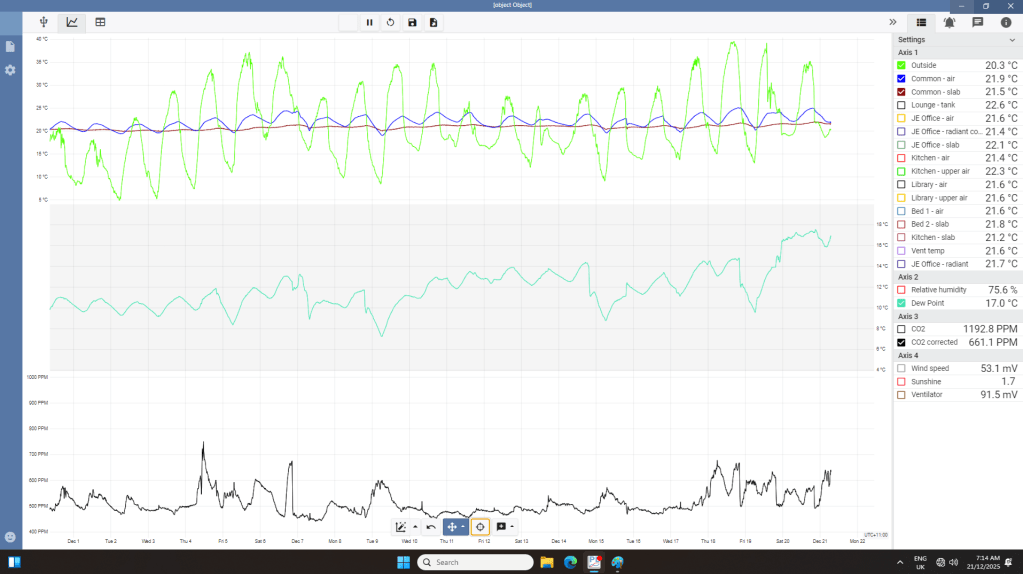
I measure and and display relative humidity in our passive solar home that we are building north of Canberra. Relative humidity (RH) can be regarded as how ‘full’ the air is of moisture; i.e. 100 per cent = full (and so condensation occurs) and 0 per cent = lots of room for evaporation.
However, in terms of judging human comfort, I find RH rather useless. This is because the human body doesn’t even notice high RH if the temperature is low, whereas if the temperature is higher, we very much notice the RH!
So I added calculated dew point to the display. Dew point is the temperature at which condensation would occur in the conditions of the RH and temp that are occurring at that moment. Because it takes into account both RH and temp, it is a very good guide to human comfort as it relates to humidity.
If you live in a temperate climate, a dew point above 15 deg C starts to feel a bit muggy. (But as with all human comfort parameters, it also depends on what you’re used to – adaptive behaviour).
So how is dew point calculated? It can get very complex and interesting, but a simplified equation is:
Dew point = Air temperature – (100 – relative humidity)/5
For more details on this calculation, including its loss of accuracy at low RH, refer to this paper.
It will be interesting to see how over the longer term in our house, dew point relates to perceived comfort – so far, it’s vastly better than showing RH alone.
 Australian Passive Solar Home
Leave a comment