

So how well does our passive solar house perform? I’ll keep this page updated as time passes.
In short, so far the house performance is excellent, achieving measured results that many people claim can be achieved in this climate only with expensive materials and specialised construction techniques (none of which have been used).
Note: In spring, summer and autumn we were not living in the house full time.
The following measurements are based on datalogging at 10 minute intervals, 24 hours a day, with temperatures shown for the middle of the house. The house is located about 80km north of Canberra.
Spring 2025
Notes: Partial occupancy, rear door sealing and internal thermal mass incomplete for most of the period; southern reflector panel not erected.
- Outside temperature varied from 0-32°C.
- Without the use of any heating or cooling systems, the house interior stayed between 18.5-24.0°C all the time. Measured interior radiant temperature was always within 1°C of air temperature – and usually within 0.2°C.
- On a few days where the dew point was high (e.g. 17.5°C), air movement via fans was needed for best comfort if the occupants were physically active.
- CO2 levels were maintained below 600ppm in all conditions.
- Occupant participation including opening and closing curtains some days; occasional opening of windows and doors for ventilation; and very occasional night flush cooling (windows and electric hatches opened, ventilator not powered).
Summer 2025-2026
Notes: Partial occupancy, southern reflector panel not erected.
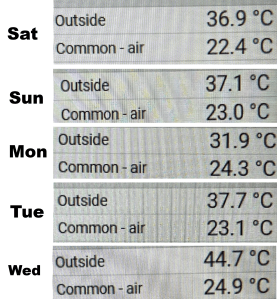
- Measured outside temperature varied from 5°C to 44.7°C.
- Without the use of any heating or cooling systems, the house interior stayed between 18.0-27°C all the time.
- The 27°C interior maximum occurred only once. It followed 6 days of temperatures over 36°C and some warm nights. Excluding this, the maximum temperature was 25.5°C.
- Measured interior radiant temperature was always within 1°C of air temperature – and usually within 0.5°C.
- On a few days where the interior dewpoint was relatively high (e.g. 17.5°C), air movement via fans was needed for best comfort if the occupants were physically active.
- CO2 levels were maintained below 750ppm in all conditions and were typically less than 600ppm.
- Frequent night flush cooling (windows and electric hatches opened, ventilator occasionally powered) was used.
- Net curtains opened only for night flush cooling; otherwise they stayed closed.
- Measured outside / inside temperatures in late January heatwave conditions:
Autumn 2026
Notes: Partial occupancy, southern reflector panel not erected.
- Outside temperature varied from 1-32°C
- Without the use of any heating or cooling systems, the house interior stayed between 16°C and 27°C all the time. However, with better user operation of the house in early autumn, this range should be able to be reduced to 20 – 25°C.
- The lowest temperature of 16°C occurred when night flush cooling early in autumn.
- It was more challenging to optimally operate the house in early autumn than in summer, with warmer soil beneath the slab and greater sunshine penetration meaning care was needed if the house wasn’t to exceed 25°C on sunny days.
- By mid/late autumn, the house temperature could be maintained, with little effort, between 20 – 25°C all the time.
- In many days in autumn, the house was opened for at least 6 hours – in early autumn this was at night, and in later autumn this was during sunny days, with especially the Office and Bedroom 2 opened.
Winter 2026
We’re now in the house full-time and the most interesting discovery we have made (in fact, it was a real shock!) was that the carbon dioxide (CO2) and Volatile Organic Compounds (VOCs) were both too high. They were not too high when compared to recommended levels – just too high for us. We therefore fitted a Heat Recovery Ventilator (HRV) system, despite my not expecting to need one. Compared to opening windows in individual rooms for ventilation as needed, the HRV slightly degraded thermal performance – but the air quality is now outstanding.
The outside temperatures are now dropping as low as -3 deg C, but the inside the house, the temperature has never gone below 17 deg C. However, when sitting at my desk, that is still a little cold for me so I am using an electric single bar radiator (750W). It is positioned to heat me rather than the room, and is typically being used for 3-4 hours a day. We are also using, for short periods (e.g. 10-15 minutes), the 3000W radiant heaters in the bathrooms. No whole-of-house heating is being used.
The southern reflector is currently being built; it will be very interesting to see how well it performs for the rest of winter.
 Australian Passive Solar Home