
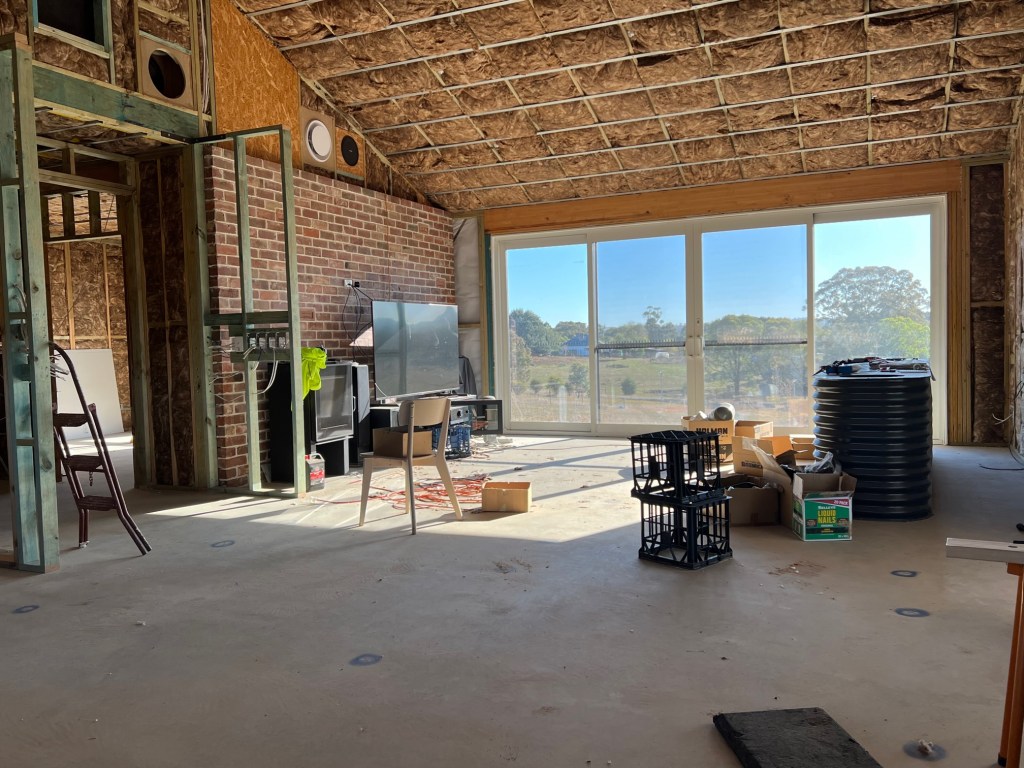
Many people seem confused about the idea of thermal mass in passive solar houses.
First, we are not talking about exterior massive construction e.g. external concrete or brick walls. Instead, the thermal mass needs to be inside the insulating envelope, i.e. in contact with the interior volume and not thermally connected to the outside air*.
Second, the thermal mass does not need to be in direct winter sunlight streaming through windows. (The image shows that but it is not necessary.) While that positioning helps in absorbing warmth, the thermal mass can be located to simply exchange heat with the inside air.
Third, thermal mass can do something that other approaches to energy efficient housing simply cannot do, and that is absorb heat generated within the house e.g. by human activity and electrical appliances.
(* It can be argued that the thermal mass of an edge-insulated concrete slab on ground is connected to the outside, but in fact it is connected to the earth, not the outside air.)
So how does thermal mass work?
If the temperature of the air inside the house is higher than the thermal mass, the thermal mass absorbs heat, reducing the rate of interior temperature increase. Conversely, if the interior temperature is lower than the thermal mass, the thermal mass releases heat, keeping the house warmer. These temperature differences between the air and the thermal mass are usually quite small – e.g. less than a few deg C. The thermal mass is never hot like an electric heater or cold like an air conditioner.
So thermal mass acts, like in cars, as a flywheel smoothing changes in engine rpm, or in electronics, like a filter capacitor reducing DC ripple.
If the thermal mass is intrinsic in the design of the house, it need add no extra cost. For example, in our passive solar home, the concrete slab thermal mass was built exactly as the engineer specified it for structural reasons. The only added expense was edge insulation – a very minor cost indeed.
Thermal mass is one of the fundamentals of cost-effective, energy efficient homes.
 Australian Passive Solar Home
Leave a comment