
On this site I talk about using thermal mass to reduce heating and cooling loads in a passive solar house. But how effective is it?
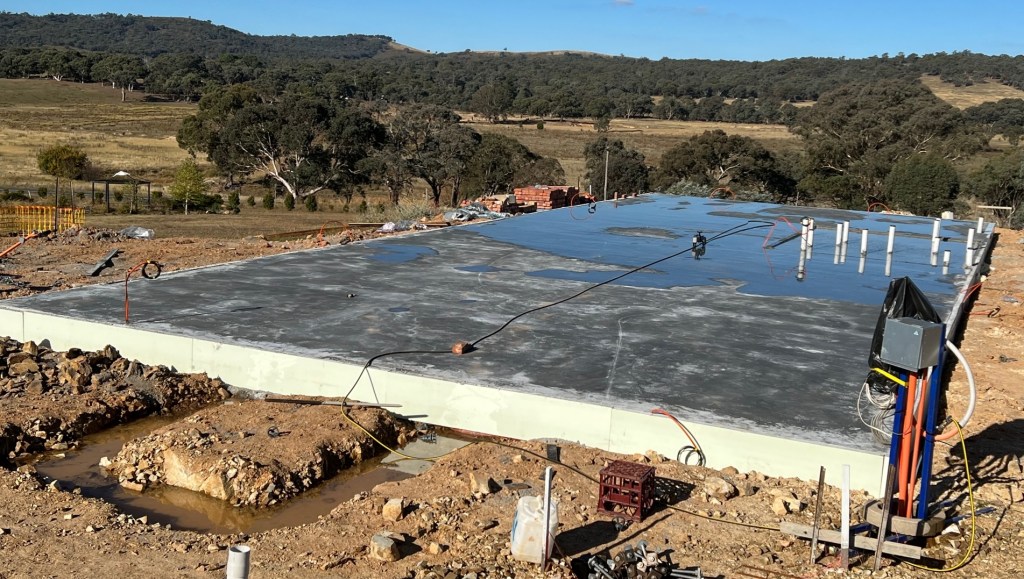
In our home, the concrete floor slab is used as the main thermal mass, and ceramic tiles are the floor covering. (The tiles allow heat transfer to and from the slab.)
To see the effect of thermal mass, I modelled the house performance with and without the thermal mass. (FirstRate5 software, one of the NatHERS packages, was used to do the modelling.) The house was modelled without thermal mass by simply adding insulating carpet in all rooms but the wet areas – so reducing heat transfer to and from the slab.
Making this one change increased the winter heating energy consumption by 24 percent, and the summer cooling energy consumption by an incredible 245 percent. (But the cooling is off a much lower base – Canberra is a heating climate.) Without thermal mass, the total annual heating/cooling energy increase was 33 percent!
So to put that another way, with this house design and in this climate, simply separating the thermal mass from the house interior by placing carpet over it increased house energy consumption for heating and cooling by one-third.
Carpet isn’t a perfect insulator, so I can only imagine the change if the thermal mass were completely absent!
 Australian Passive Solar Home
Leave a comment