
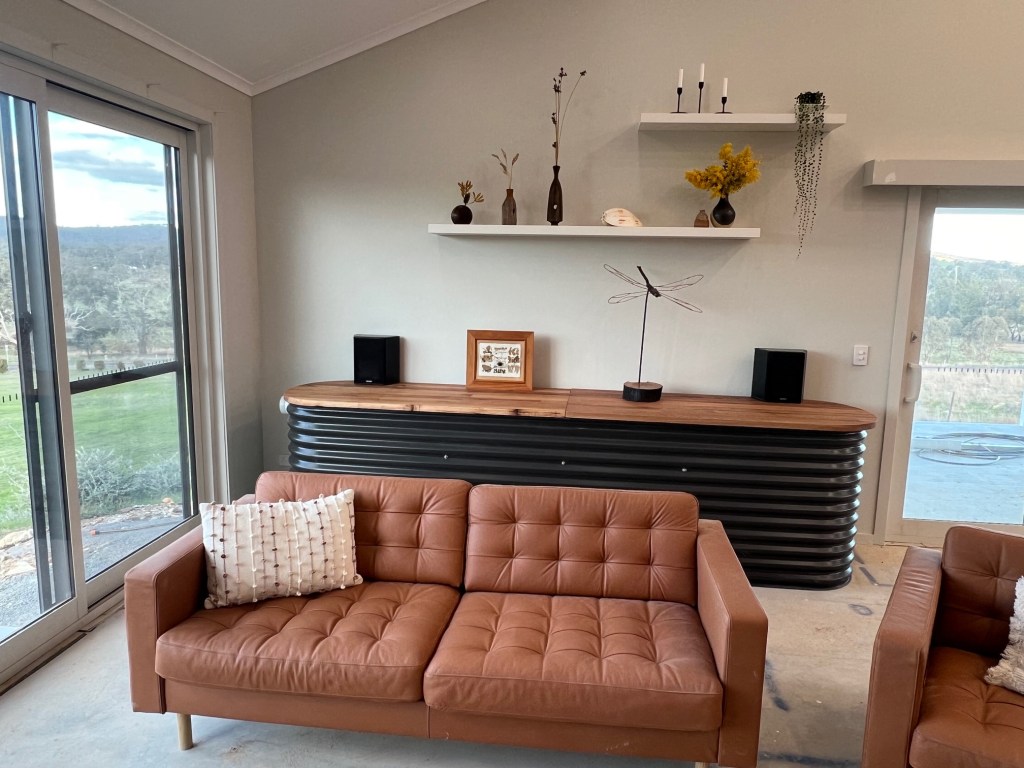
One area that causes most confusion when describing the operation of our passive solar house is the action of the thermal mass. The thermal mass comprises the concrete slab (slow response), an internal brick feature wall (faster response) and three internal water tanks (fastest response). Let’s look at how the lounge room tank, shown here behind the chairs and before the floor was tiled, warms that space.
Imagine that both the late afternoon daytime air temperature in the room, and the temperature of the water in the tank, are at 21°C. It’s winter and as night draws near, the outside temperature starts to fall. Because of heat loss through the walls, ceiling and windows, the inside air temperature also starts to drop.
As the inside air temperature falls below tank temperature, heat starts to automatically flow from the tank to the air in the room. The greater the difference between room air temperature and tank temperature, the more heat that flows. Therefore, because of the tank, the room air temperature is higher than it would otherwise be – the room is being heated. The air temperature stays higher until the tank temperature is the same as room temperature – all the heat has been used.
So what happens the next day? Let’s imagine that at dawn, both the room and tank temperatures are now 17°C. Winter sunshine warms the room, and everything in it. By 10am the air temperature in the room might be 19°C, and so heat flows from the room air into the tank. Because the tank is absorbing heat, the air temperature rises more slowly than it otherwise would, but rise it slowly does. By – say – 3pm the tank and room temperatures have equalised at (for example) 21°C, and the tank is storing warmth, ready for its role that evening.
There are a couple of things to note. First, the tank is called ‘thermal mass’ because it resists the change in room temperature – both upwards and downwards. Second, the tank temperature is never greatly different to the room temperature – at any time there’s normally less than 3°C difference. Third, if there is no winter sunshine, the tank temperature will not rise much during daytime. (This is why the tank is only part of the thermal mass of the house – the concrete slab ‘works’ over periods of multiple days.)
Finally, there are also radiant heat transfers from the tank to the room occupants, but I’ll cover that another time.
 Australian Passive Solar Home
Leave a comment