
If fibreglass insulation gets moist, its effectiveness is much reduced. Moisture may be introduced from the exterior (e.g. wind-driven rain entering through gaps in the cladding and vapour membrane) or from the interior (e.g. water vapour making its way through the plasterboard and then condensing in the insulation). The latter is the most likely scenario, especially as in our house there is no vapour barrier on the inside of the walls.
To reduce the likelihood of condensation occurring in the insulation from internal water vapour, in our house as little moisture as possible is added to the interior air. For example, bathroom towels are dried outside, the clothes drier is a heat pump with internal collection of condensation, and effective kitchen and bathroom exhaust fans are used. Also, whenever the outside temperature is higher than the slab (winter) or lower than the slab (summer), the house is opened for ventilation.
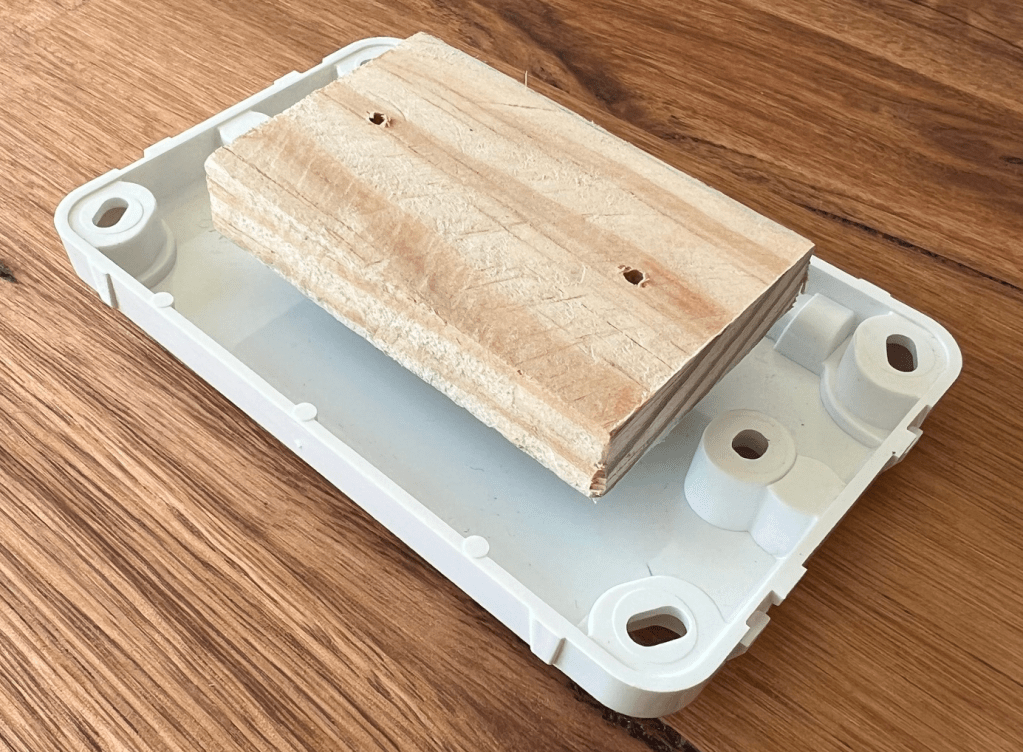
However, even with these precautions, during the house build I thought it a good idea to add some insulation moisture monitors. These comprise blank switch plates with two stainless steel screws placed through them into a block of pine mounted on the rear face. The idea is that if the moisture level in the pine rises, this will be measurable by the changed electrical resistance between the two stainless steel screws. This resistance can be measured with a normal multimeter, and the heads of the Allen-head screws are accessible without dismantling anything.
 Australian Passive Solar Home
Leave a comment