
Most passive solar homes will need some form of mechanical heating and cooling. The systems will likely be used rarely, but they will be needed. So how do you pick them?
The first important aspect to consider is the basic philosophy that is to be adopted: do you aim to heat the house, or the people in the house? That sounds like a rather simple question, but the answer makes a radical difference to a whole range of aspects – comfort, energy consumption and equipment cost.
The answer is also dependent on culture and climate. For example, in northern European and US cold climates, traditionally the whole house has been heated. In contrast, in mild climates like southern Australia, heating of the people within the house was more often done. That’s because in a mild climate, when the person moved away from the heater, the house wasn’t dangerously cold – it was just a bit uncomfortable.
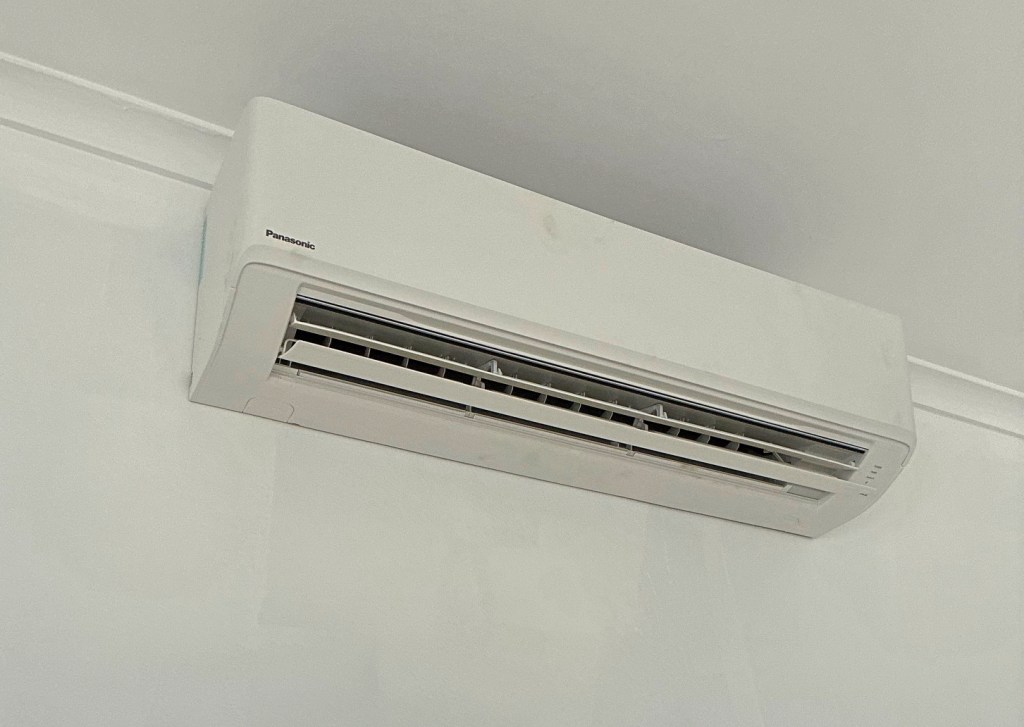
Examples of systems that heat or cool the house are split system reverse cycle air conditioners, and ducted heaters and coolers. Examples of systems that heat people in the house are desk and ceiling fans, electric radiators and electric blankets on a bed. Some heat sources, like a wood stove, do both – they heat individuals primarily by direct radiation, and heat the house by convection.
An allied question is: will the whole of the house be cooled and heated equally, or will there be zones in the house that are warmer or cooler than other zones?
I believe that it is better to heat and cool people rather than houses, and that the house should be zoned depending on the use individual rooms are being put to.
Bedrooms are an example of this zoning. Because people spend (most of!) their time in bed asleep, where activity level is low and position is fixed, bedrooms can be cooler in winter and warmer in summer than other rooms. Therefore, heating can be – for example – by an electric blanket (or more bed coverings, etc), and cooling can be via a ceiling fan. Given that bedroom floor space in many houses is about one-third or more of the total area, you can see that making a decision like this can radically reduce cooling and heating needs.
Many teenagers spend a lot of time in their bedrooms. In this case, the room as a whole is individually zoned for heating and cooling.
A home office is another example. If you are seated at a desk, an under-desk radiant heater is very effective at warming you in winter, both by direct radiation and convectional air circulation in the small volume under the desk. In summer, a desk or ceiling fan will be effective at cooling.
In a bathroom, summer cooling is unlikely to be a problem (just use colder water when washing) but bathrooms, especially if they’re on the southern side of a passive solar home, can be cold in winter. This short duration, high energy requirement for heating can be met by a wall-mounted radiant heater or ceiling-mounted heat lamps. Radiant heating is particularly effective in bathrooms because of the lack of clothing covering the skin.
Two other points:
• Heating and cooling of individuals (rather than houses) typically requires fast-response heaters.
• Heating and cooling in zones require that areas within the house are able to be isolated, e.g. by closing doors. Internal walls should also be insulated.
The approach that is to be taken to mechanical heating and cooling should be considered early in the house design process.
 Australian Passive Solar Home
Leave a comment