
The whole purpose of NatHERS software packages (all of which use an underlying engine developed by the CSIRO) is to do energy rating assessments to meet legal standards. Therefore, there are all sorts of conventions are followed so that there is universality in comparison of different house designs.
For example, the functions of rooms must be strictly nominated. This is important, because the function of a room can make a difference to the overall star rating. Why? Because some types of rooms (e.g. bedrooms) are permitted a wider temperature variation than others (e.g. living areas).
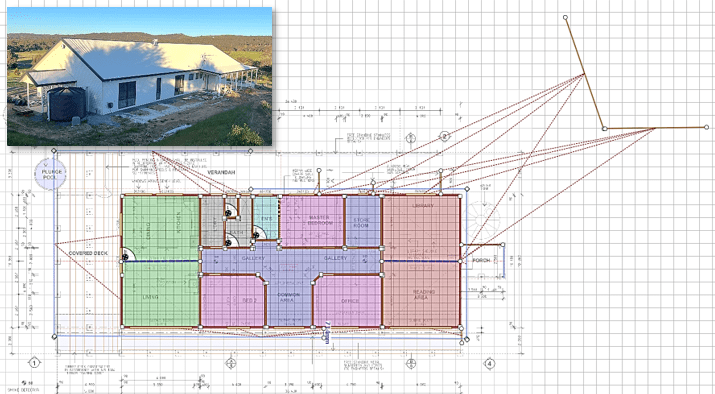
But if we’re using the software for design development, we can ignore a lot of those conventions. For example, we can name a room an office rather than a bedroom – if indeed it is to be used as an office. We can nominate a storeroom as an ‘unconditioned’ space (i.e. it is not being included as a room that needs to be kept appropriately warm and cool). The NatHERS convention requires that trees not be used to provide shading – but you can put in obstacles (representing trees) where there are trees (image above).
Especially if you are paying someone to do the modelling, you may have to pry them from their conventions so that they are able to better model the house that you’re actually designing.
You also need to be aware that there is a lot that the software cannot do – especially if you start designing something more radical. There is no direct way of modelling added internal thermal mass provided by drums of water, or by taking into account solar insolation from reflectors placed on the southern side of the house. You also can’t model a Trombe wall (an inside brick or stone wall placed behind glass, that acts as a combined solar energy absorber, flat plate heater and storage mechanism).
However, the software is still enormously useful, and you should always model your basic design – even if it is then further tweaked with elements that cannot be modelled.
 Australian Passive Solar Home
Leave a comment