
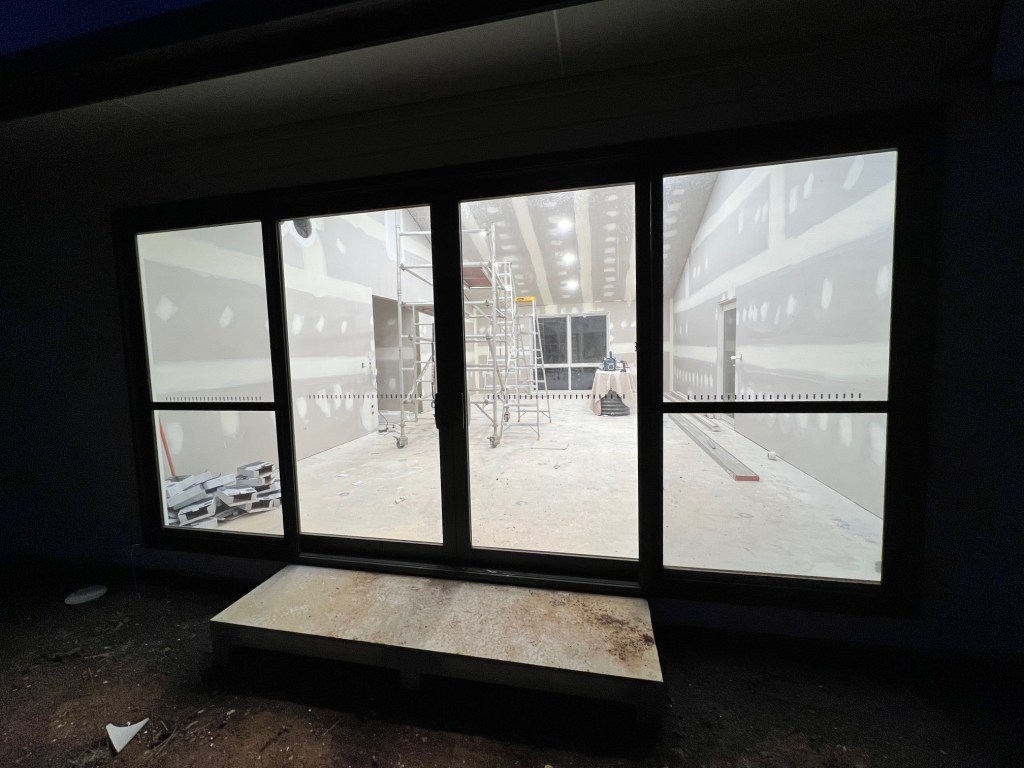
In a passive solar house design, window area and orientation are critical to performance. Pictured here are the northern windows / sliding doors to our library (yes, it’s a big space). In winter, the sunshine floods into this room, the sun reaching about half way across the 10-metre room depth. In summer? No direct sunshine enters.
More technically, the temperature the room reaches in winter depends not only on the northern window area but also the room’s thermal mass – the ability of the room’s fabric to absorb the sunshine’s heat. In this case, that thermal mass is provided largely by the concrete floor slab.
In the past, rules of thumb relating window area to floor area were often used when doing house designs, but these days, low cost software can model interior room temperatures. For example, on a sunny day in winter at 1pm, when the outside temp is 7 deg C, the room is predicted to be 20 deg C. (So far, with about 6 months of measurement, the software looks pretty accurate.) That heat, stored in the slab, then warms the room that night.
In fact, the time constant of the slab is about 5 days – so it will still work even if there’s been no sunshine that day… or the next or the next.
 Australian Passive Solar Home
Leave a comment