
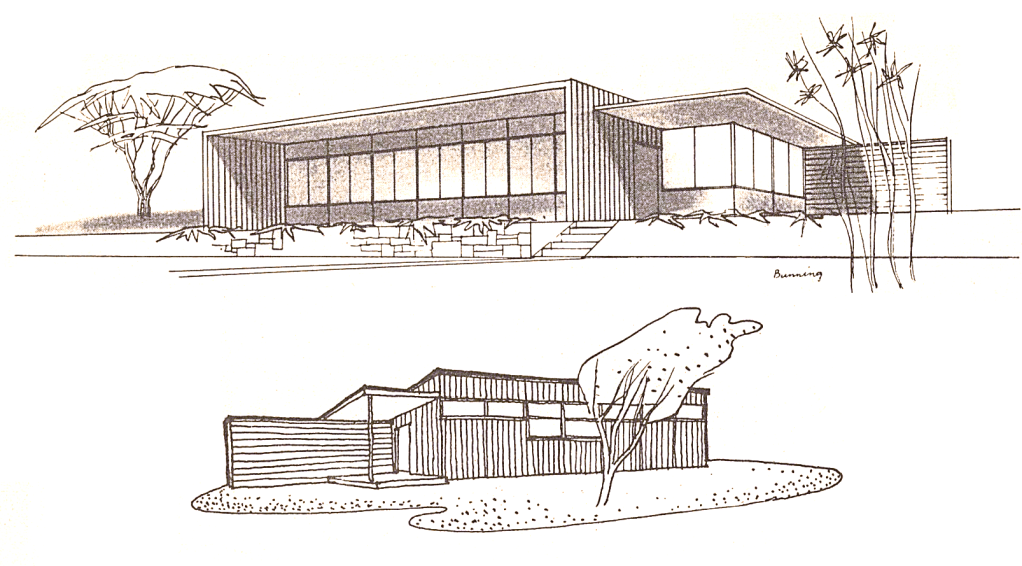
Many people suggest to me that what I am describing in passive solar design of houses is something new or unusual. (Passive solar design = orientation, window area, shading, insulation and thermal mass.) It’s not – it’s just been apparently forgotten by so many!
Here’s a good example. Way back in 1945, Australian architect Walter Bunning produced a fascinating book, entitled ‘Homes in the Sun – the past present and future of Australian housing’.
What makes the book particularly significant is that it lays out his view of how post-WWII homes, communities, towns and regions could be developed to better suit the Australian environment.
In the book Bunning covers what he specifically describes as a solar house.
“[The] solar house is designed on the scientific principle that the eaves of the roof extend just far enough so that the sun’s rays penetrate into the rooms in Winter, but not in Summer. All the main rooms face north behind a virtually unbroken expanse of clear glass. If the eave is the right width it excludes the direct rays of the high Summer sun and renders interiors cool, but when the Winter sun swings low on the northern horizon its beams slant in under the eave and flood the house with heat and light.”
Bunning then went on to suggest a design, with the plan view and sketches. Significantly, though, there is no mention of thermal mass in Bunning’s descriptions, and insulation is regarded as a new product and is not specifically recommended for use in the solar house.
But that was 80 years ago…
 Australian Passive Solar Home
Leave a comment