
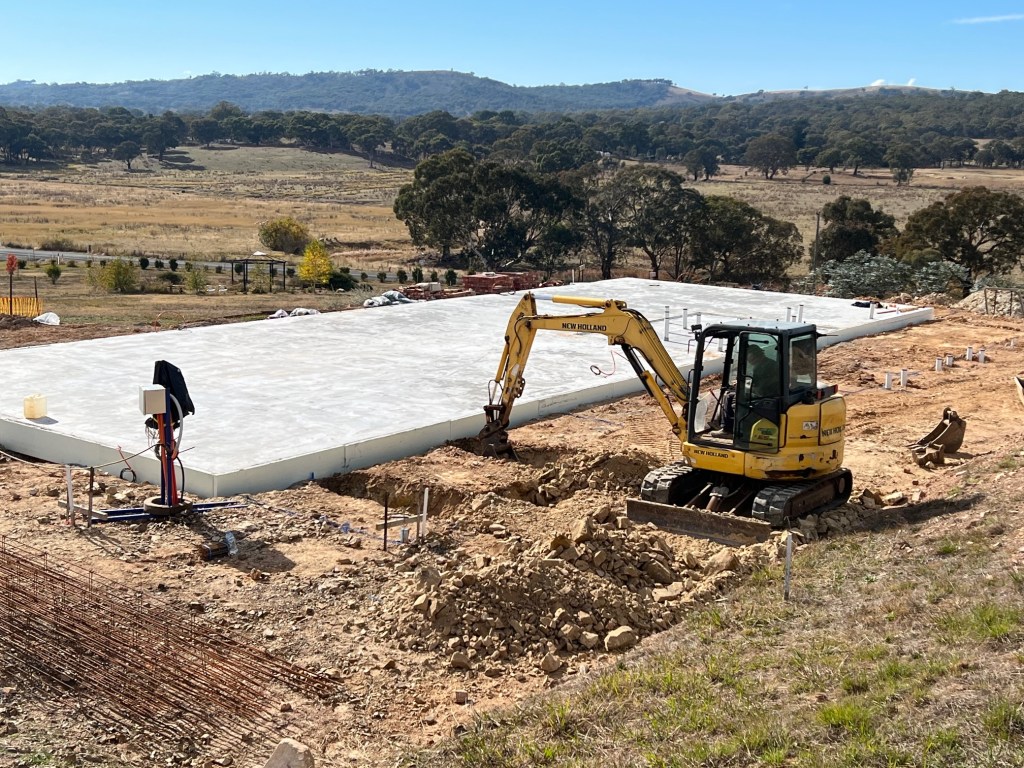
Georgina came up with a very interesting point regarding thermal mass and how people operate a house.
We had visited a well-insulated and sealed house with the thermal mass provided by about 2000 litres of water. While water is excellent at storing and exchanging heat, 2000 litres of water is very little thermal mass for a 180m2 house. (For example, it’s approximately one of our Library or Lounge water tanks, albeit in a smaller house.) Other than the water, this house had basically no thermal mass – no concrete slab, for example.
When we visited, the house was 5 years old. The owner described learning how to best operate the house, and implicit in his descriptions were that decisions were made on a daily basis. Whether to open the house that night to cool it; whether to operate the reverse cycle air conditioner – and so on.
As Georgina commented, apparently it all needed to be decided quickly.
And when we reflected on that, it makes sense. By definition, a house with little thermal mass is highly reactive to outside temperature changes. (And inside heat generation, too.) On the other hand, a house with a lot of thermal mass has an underlying temperature cycle (time constant) that is measured in multiple days – in some cases, a week. That is, the daily house temperature variations are driven not only by the outside temperature, but the temperature of the thermal mass. Therefore, deciding whether to open the house at night in summer depends on both the temperature of the thermal mass and its trend over – say – five days.
Of course, you don’t have to operate the house like a military operation, monitoring slab and interior temperature sensors and making strategic decisions! Instead, in the above scenario, where thermal mass is gradually warming, you might simply say in summer, “The house is starting to get a bit warm in the daytime; we might open the windows tonight.”
To put all that in a nutshell, in a house with high thermal mass, things happen slowly. For example, if we are away from the house all day, we can be confident what the internal temperature will be when we return home – it won’t have changed much since we left.
There’s also an interesting but subtle element in this. I don’t want to become overly metaphysical, but there’s something very relaxing about a house that, while it gets warmer and cooler over each 24-hour cycle, naturally varies in mean temperature quite slowly.
 Australian Passive Solar Home
Leave a comment