
Someone, commenting on the thermal mass behaviour of our passive solar house north of Canberra, said, “The [concrete] slab is going to respond very slowly to its adjacent environment, probably over days or weeks not hours. […] The water, on the other hand, can respond much more quickly…”
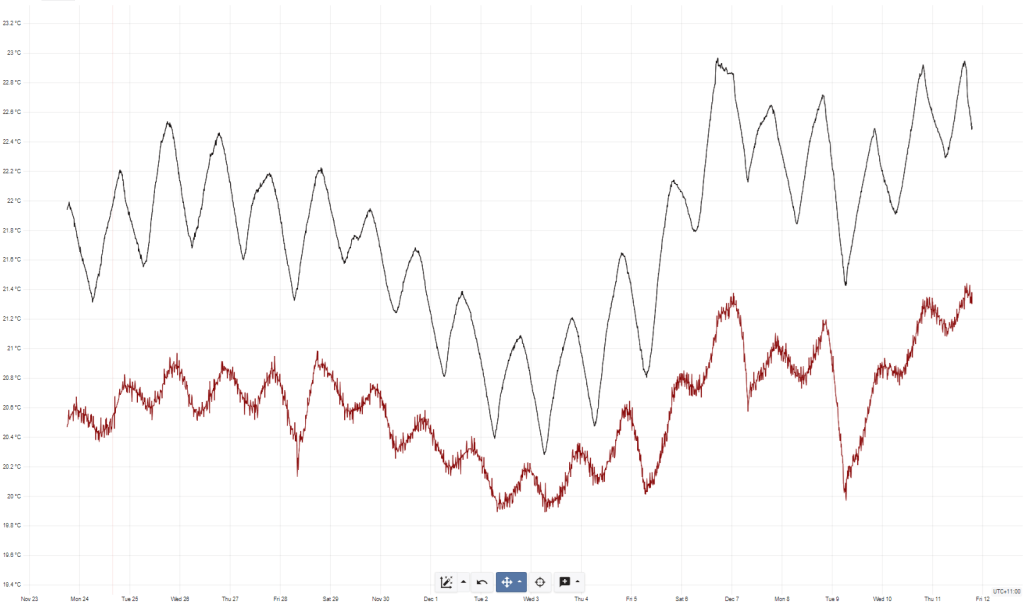
However, as this graph of the temperature of the slab and of one of the internal water tanks shows, both the slab and water temperatures are quite dynamic. In short, they vary on a daily cycle, superimposed on a cycle of about 7-10 days that largely reflects average outside temperature. Changes over hours can be easily seen.
Over the last 19 days, the slab temp (red) has varied from 19.9 deg C to 21.4 deg C, with the daily cycle clearly visible. But you can also see the general fall over the first ten days, and then the rise over the next 9 days (punctuated by a sharp drop when I opened the house overnight).
Not surprisingly, the same pattern is repeated by the water, but with greater daily variations and with it sitting typically about 1.5 deg C warmer than the slab.
Of course, the total temperature variations are tiny – over the 19 days, 1.5 deg C for the slab, and 2.7 deg C for the water. But each degree change in temperature represents large heat exchanges with the air inside the house.
And outside? Over the same period, the temperature has varied from 5 deg C to 37 deg C.
(Notes: the noise on the slab trace is an artefact; slab temp measured in the middle of the house at 75mm depth; 2000 litre water tank)
 Australian Passive Solar Home
Leave a comment