
In an energy-efficient home, thermal mass can play a critical part in controlling interior temperature swings. Think of how an underground cave barely changes in temperature – it’s surrounded by thermal mass… earth and rock in that case.
When measured per unit volume, water is the best thermal mass that is readily available, cheap and non-toxic. In round figures, water has about double the thermal storage capacity of concrete, and furthermore, because convection currents are set up within the water, the heat is better transferred through the volume.
However, the issue with water is that, while it may be very cheap, its storage is not. Furthermore, it’s hard to package as part of the house. On the other hand, a house can make use of a poured concrete slab, and/or internal concrete or brick walls, to provide thermal mass. In other words, the thermal mass can be part of the normal house fabric.
Our passive solar home has a 150mm thick concrete slab. It is about 40 cubic metres in volume, so to replicate this in water would need about 20 cubic metres (20,000 litres) of water. (This is a simplified calculation – the slab is in contact with the ground, which changes things, and has deep pillars, which changes more things, and doesn’t have the convectional circulation of water, which changes even more things.) The slab was built exactly as the engineer specified it for structural reasons, not as extra cost thermal mass.
A house I visited the other day used water to provide thermal mass. The house was about a third smaller than our house, but it had only 2000 litres of water storage for thermal mass – 1/10th the equivalent of our slab. I think that’s far too little thermal mass in a southern Australian climate – better than nothing, but insufficient on its own to stabilise interior temperatures.
However, what water is very good at is acting as a fast-response, smaller thermal mass working in concert with a larger thermal mass. For example, when in summer the concrete slab is slowly warming layer by layer, so reducing the rate of interior temperature rise, water thermal mass in the same house will be heating much more quickly – and its natural circulation will be using all the available storage volume.
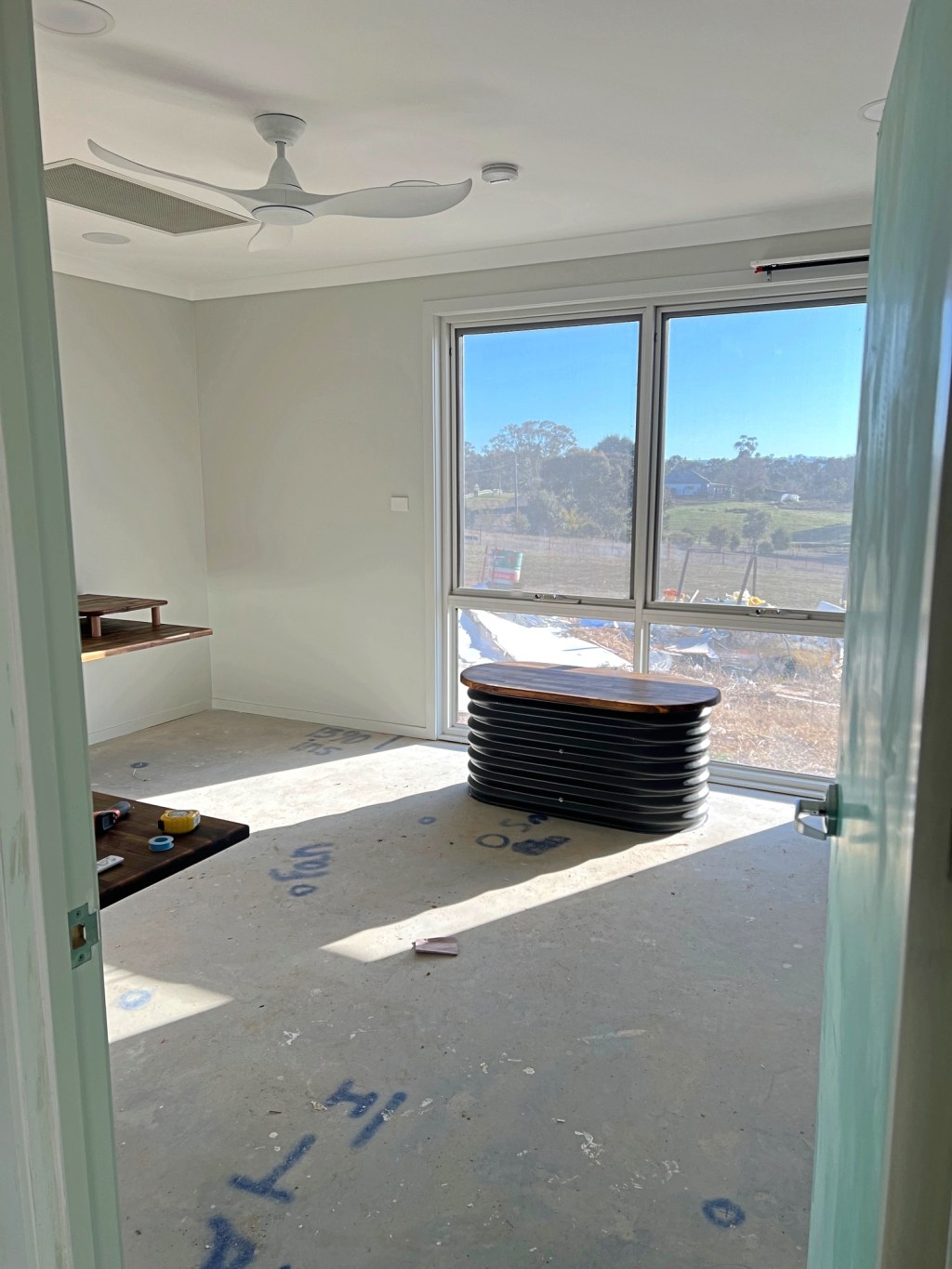
The pic above shows the 350 litre water tank I am using in my home office. In this case, it is also directly exposed to winter sunshine, so works as a collector/storage system too.
Thermal mass is an interesting area – it can add no cost at all to a house and yet radically change interior comfort.
A final three points.
Thermal mass must always be positioned inside the insulated envelope. External brick veneer, for example, adds basically no thermal mass.
In an un-airconditioned house, often a bathroom in summer is the coolest room in the house. That’s because it has plenty of exposed thermal mass, including the wall and floor tiles.
Finally, thermal mass can do something in summer that other energy efficient housing approaches simply cannot do without artificial cooling – reduce the temperature increase from internally generated heat like humans and electric appliances.
 Australian Passive Solar Home
Leave a comment