
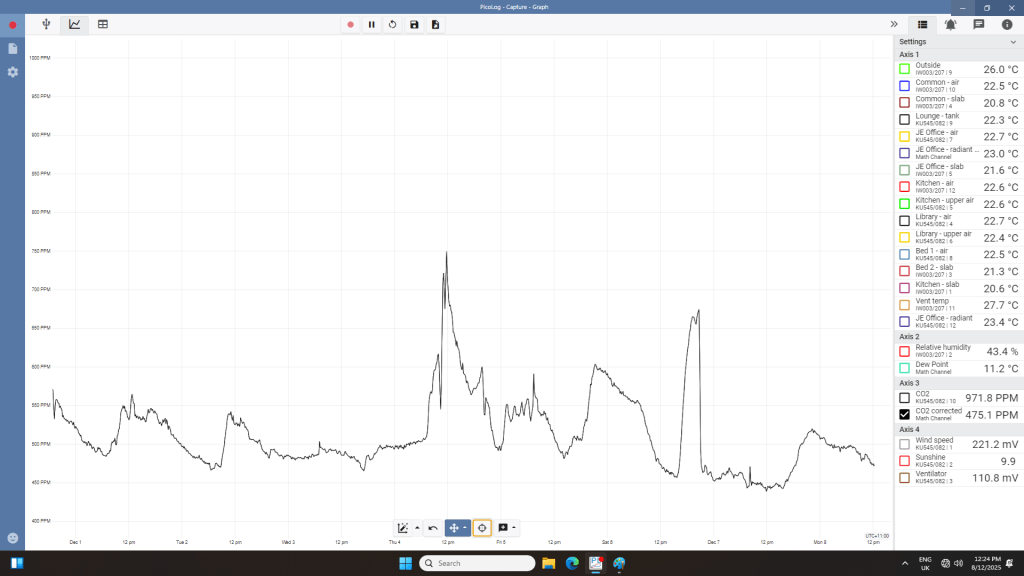
Measurements of CO2 levels in our passive solar house have been very interesting. Outside air is around 400 PPM; inside a dwelling you want to keep levels below 1000 PPM.
CO2 is primarily increased through occupant exhalations.
The more you seal up a house, the higher the CO2 levels will be without ventilation.
The less you seal a house, the lower will be the CO2 levels, but the more energy you will spend on heating and cooling.
If you seal a house very tightly and use mechanical heat recovery ventilation, much the same idea applies – the more ventilation you use, the more energy you will need to heat and cool (i.e. the heat recovery is not 100 per cent efficient).
People with mechanically ventilated houses love saying that the air quality in a traditional house is poor, but that depends on how well ventilated it is. The data I have seen for sealed houses with ventilation systems shows that the CO2 levels are typically kept below 1000 PPM. But as far as I can see, that’s easily achievable in any house.
The graph shows the measured interior CO2 levels for about a week in our new house. Importantly, we are not yet living in the house, but people are in it every day. The highest recorded value has been 750 PPM – that occurred with two tradespeople in the house working hard (i.e. exhaling a lot!), plus my presence as an observer. Typically, the CO2 level has been under 550 PPM.
Obviously we will see what the levels are like when living in the house full-time, but based on these measurements, I don’t see a problem. The potential exception is a closed bedroom at night – there, with the smaller room volume and sealed door, the rise in CO2 could be high. If you vigorously exercise indoors, that is also likely to increase CO2 levels.
One thing is clear: CO2 levels can rise and fall very quickly in a house, so it is definitely worth monitoring this variable.
 Australian Passive Solar Home
Leave a comment