
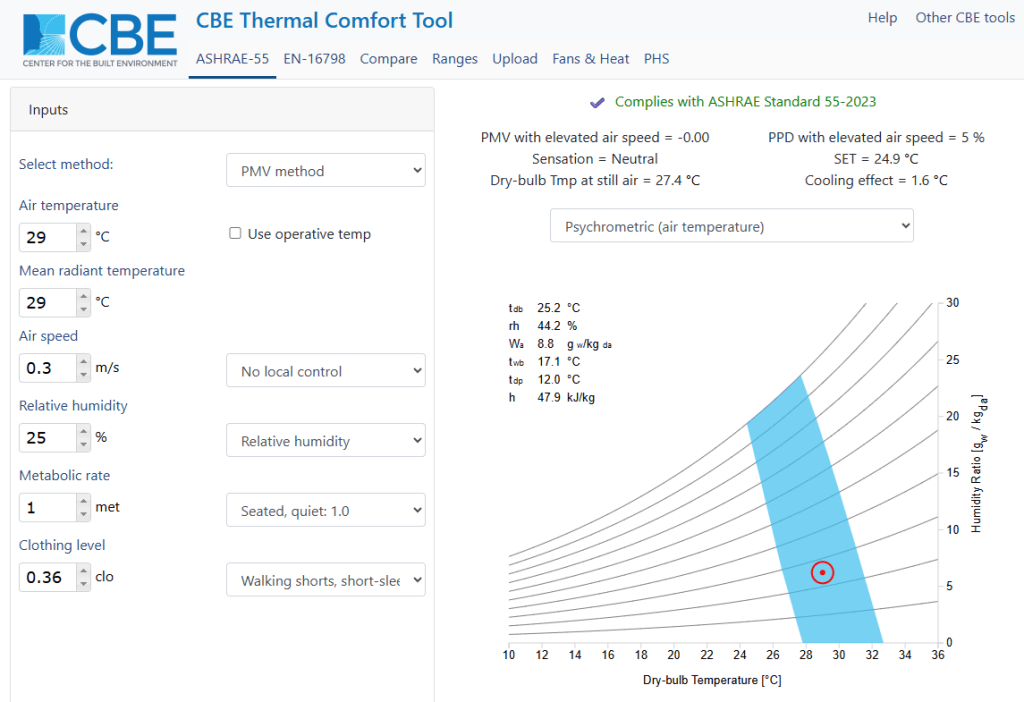
The Centre for the Built Environment of University of California, Berkeley, has an excellent online tool to assess the factors influencing human comfort.
The online tool requires entry data required for:
• air temperature
• mean radiant temperature
• air speed
• relative humidity
• metabolic rate (i.e. human activity level, with examples provided)
• clothing level (again with examples provided)
By altering any (or multiples) of these factors, their effect on human comfort can be seen.
Incidentally, clothing levels are measured in Clo units, with 1 Clo being about the equivalent of wearing a business suit. In R-values, 1 Clo = R0.16 – so not much!
What the tool shows very clearly is the importance of the following in providing a comfortable thermal environment in your house.
In warm conditions, having adequate airflow (e.g. 0.3m/s), relative humidity below about 50 percent and mean radiant temperature that is not high relative to air temperature.
In cold conditions, no airflow (i.e. no drafts) and mean radiant temperature that is not low relative to air temperature.
In both cold and warm conditions, it’s important that appropriate clothing is worn. The latter is probably not a problem at home (except perhaps if you are working from home and participating in online meetings requiring formal dress, at least of the upper half), but it may be a problem in some workplaces that have non-appropriate dress codes for the climate.
Have a really good play with the tool – it can dramatically change your understanding of what are comfortable conditions. It also shows how house energy modelling packages that place a major emp
 Australian Passive Solar Home
Leave a comment