
In this blog I have repeatedly stated that you don’t need special materials or trades to build an energy efficient house. Our house is evidence of that.
However, I have also stated that you should have professional inspection of any house you are building yourself – or having built. So what do I mean by that – and why is that the case?
Well, in Australia, the quality of tradespeople varies a great deal. Some – many, in fact – are dedicated to doing a good job that they will feel proud of. I can honestly state that was the case with our house. However, many have also fallen into dual traps – punch the work out as quickly as possible, and/or have developed bad habits that reduce the quality of the work.
For example, in energy efficient passive solar houses, insulation must be carefully installed so that there are no gaps. Even tiny gaps will let heat through – it is absolutely vital that the insulation is installed carefully and professionally. Any gaps too small to be filled with insulation, e.g. around window reveals, should be sealed with expanding foam. Doing this well is time-consuming and fiddly.
Vapour permeable membranes are installed on the external walls of all houses. It’s again vital that these are installed correctly – e.g. with the right overlaps where multiple layers are needed, and taped where appropriate (most places).
Plasterboard, cornices and skirting boards should provide an internal airtight seal after installation. This means the use of continuous beads of cornice cement, and gap sealing of skirting board edges before painting.
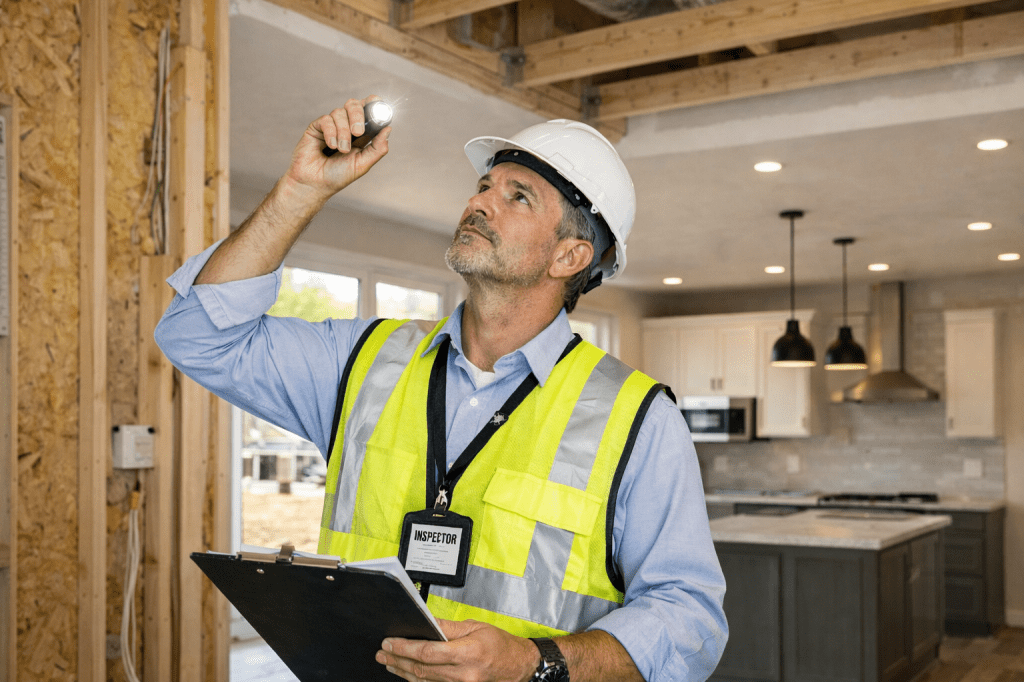
An independent inspector, employed by you (and not for example the building company!), puts the trades on notice that everything is being looked at with professional eyes. Such inspectors are available in every Australian state, and in the context of the total cost of a house, their fees are quite small.
It’s important that such an inspector is briefed on the fact that in addition to checking on normal construction quality, you’re particularly interested in having them assess the build quality that influences energy efficiency. Examples include the aforementioned membrane and insulation installation, but also maintaining the integrity of the building envelope by sealing external penetrations (e.g. pipes and wiring), and ensuring the materials stated on the plans are being used (e.g. the wrong windows haven’t been delivered).
This report, prepared for the South Australian Government in 2014, highlights aspects that an inspector should check – see section 2.6. (Not much seems to have changed since the report was written.)
Employing an independent professional building inspector is a vital step in the construction of a passive solar home.
 Australian Passive Solar Home
Leave a comment