
If you are building a passive solar house, it’s critical that you think of energy efficiency from the very beginning of the design process. Band-aid fixes for poor energy efficiency are typically expensive, difficult and basically a PITA.
Nearly every single major decision that you make about the house design will have an impact, in some way, on energy efficiency. The shape of the house; the number, size and location of the windows; the internal layout; the materials with which you make the floor, the walls and the roof – everything!
People tend to think of aspects like insulation levels (R2? R3? R4?) and the quality of the windows (single or double glazed? aluminium, timber or uPVC?), and while these of course will impact energy efficiency, at least as important are the shape of the house, whether you use a suspended timber or concrete slab floor, and the size and direction most windows face (i.e. the orientation).
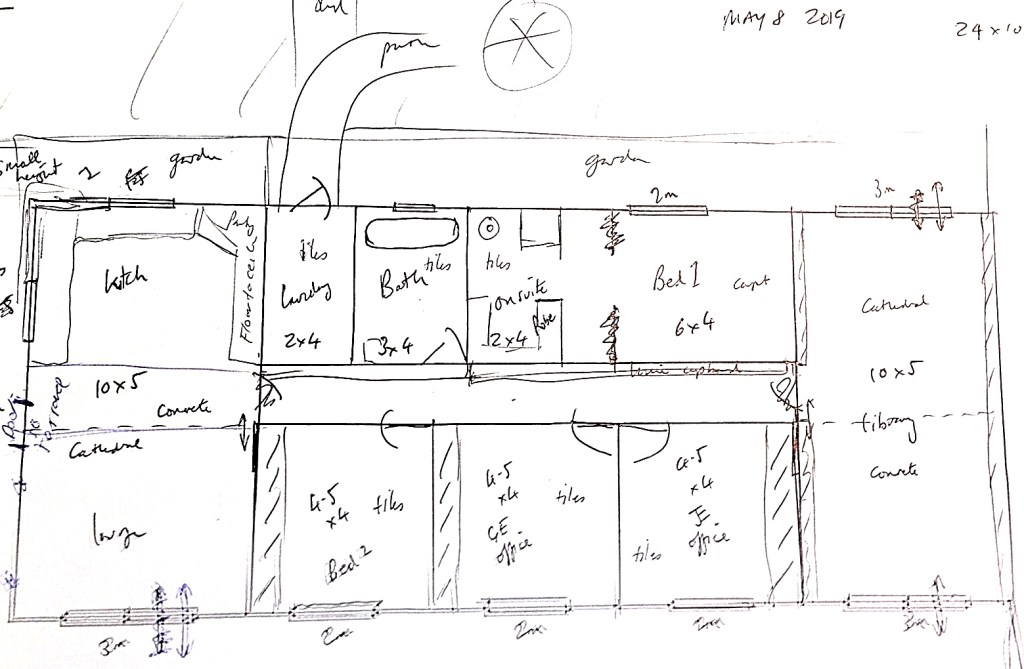
Here’s an example. When I designed our house, I used all the fundamental rules of passive solar design to come up with a starting point. On that initial sketch, the house was rectangular, with the long axis east-west. Lots of northern glazing was used, suitably shaded in summer – but not winter – by an eave. There was very little glazing on the west, not a lot of glazing on the east, and the southern glazing was strategically chosen. As an example of the latter, the southern kitchen windows were sized and shaped to give the required view – and no more.
A concrete slab was used to give thermal mass.
Insulation was chosen again by rule of thumb for this climate zone – R2.5 for the walls, and R5 for the ceiling. The Colorbond roof was insulated with R1.3 Anticon. I can’t remember the window details but when all this info went to an architect who was to do the NatHERS modelling, he suggested better quality windows. He picked them – and they were just off the shelf, double glazed, thermally broken aluminium designs.
So we’re talking a basic, simple house – nothing flash or innovative, all materials available from local suppliers; not expensive.
So what was the NatHERS star rating? Immediately, it was 8 stars. In our Canberra climate, that indicates a heating/cooling energy use that’s 36 per cent better than the legally required 7 star rating.
To put this another way, because the fundamentals of orientation, shading, insulation and thermal mass were always part of the design, even with no further tweaking, it was already an energy-efficient house. (And, incidentally, the same design rates over 9 stars in the Sydney climate!)
Develop your initial house design using passive solar fundamentals, and then change it from that position to further match your needs, desires and requirements. If the starting point follows passive solar design principles, you’ll find that usually you can modify the house substantially and still end up with an energy efficient home.
But not if you try to do it the other way around!
 Australian Passive Solar Home
Leave a comment