
When it comes to energy efficient home design, I am a traditionalist. The passive solar techniques that I think work well – orientation, thermal mass, shading, insulation – have been practiced for 50+ years. However, what really has changed in recent decades is the use of simulation software, especially in assessing a house’s dynamic thermal performance.
I am no software expert, but it seems to me that the key aspect of energy simulation in house design is not to assess just heat loss and gain (e.g. by quantifying heat movement through the thermal envelope / windows), but to also assess the dynamic nature of those heat movements, especially in terms of the action of thermal mass.
In short, old rules of thumb and basic calculations, while useful in terms of setting initial design goals, are now outdated by simulation.
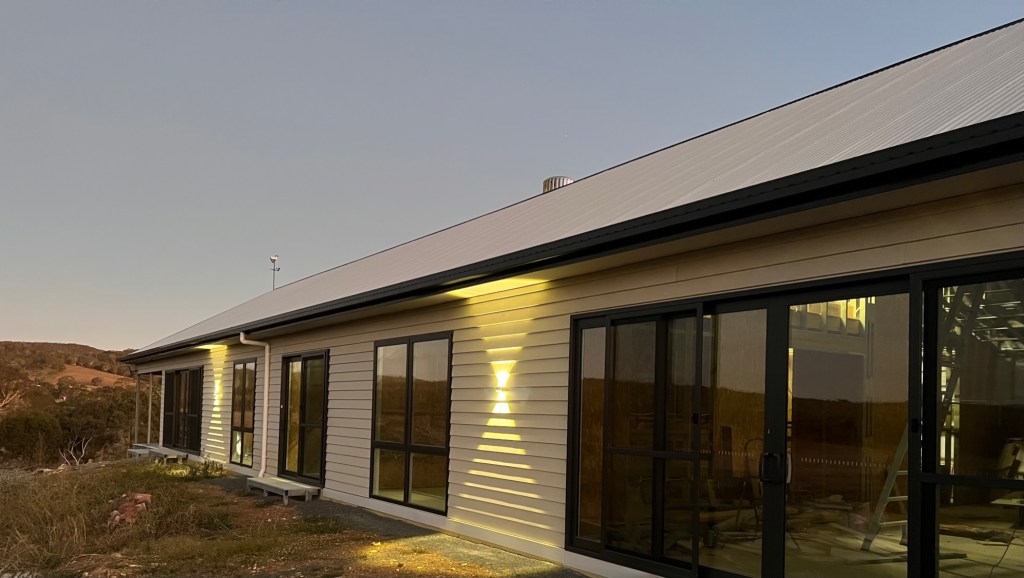
I am prompted to write this after someone, viewing the pictured northern aspect of our passive solar house, wrote that it would never work. The energy gain in winter from those big northern windows (i.e. from the sun shining through them) would be negated by their heat loss; that is, overall, the windows are a big negative. The commenter did lots of calculations to show that what he suggested was the case.
Except it isn’t.
NatHERS software simulation – and not surprisingly, the measured performance of the house – shows the design is working well. The heat gain through those windows, stored in the thermal mass, keeps the house warmer in winter. In summer, the eaves shade the windows, and furthermore, we use net curtains that reduce the indirect solar gain. These large northern windows are an integral part of what makes the house work.
Our house design is a very simple one – a major reason it cost no more per square metre than any standard Australian house. But with some basic passive solar design, tweaked by software modelling, it shows what can be achieved.
That NatHERS software modelling – a dynamic model – is so widely available and at such a low cost, is one of the miracles of Australian home design.
 Australian Passive Solar Home
Leave a comment