
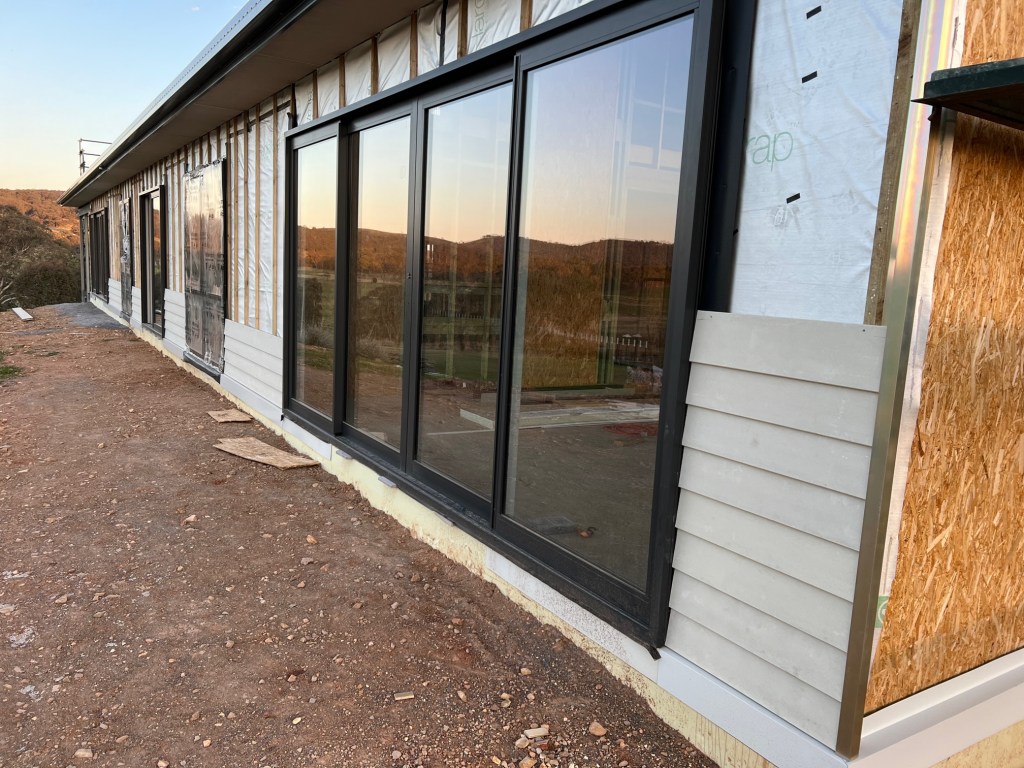
Windows in houses, yes even double glazed ones like these, act as big thermal holes in walls. That is, they let much more heat pass inwards and outwards than the insulated walls in which they are placed.
In a house windows have multiple functions. They let in light, they provide views of the outside, and they can be opened for ventilation. These glazed sliding doors also allow movement into, and out of, the house.
In a passive solar home, windows on the north have another, very special, function. They allow solar radiation – sunlight – to enter during winter, warming the house. (The carefully designed width of the eaves prevent the higher angled summer sun from doing the same.) So the northern windows have more of a benefit than a loss – they provide free heating in winter. But what about the other windows?
East and west windows are problematic because of summer heating. They cannot easily be shaded by eaves as the sun in the early morning and late afternoon is too low in the sky to be easily blocked (except by strategically planted vegetation). West windows are particularly a worry as they get summer afternoon sunshine when the house has already warmed.
South windows are, in energy terms, a dead loss.
So does that mean a passive solar home has windows only on the north? No it doesn’t, but it does mean that typically the windows on the other faces are sized very carefully. One example in our house is the kitchen’s south window. It was sized and positioned specifically to give my wife Georgina exactly the view she wanted. And no bigger than that!
This is another area where a passive solar home need cost no more than any other home. Just juggle the window sizes and positions so that the total cost doesn’t change… but the energy efficiency does.
 Australian Passive Solar Home
Leave a comment