
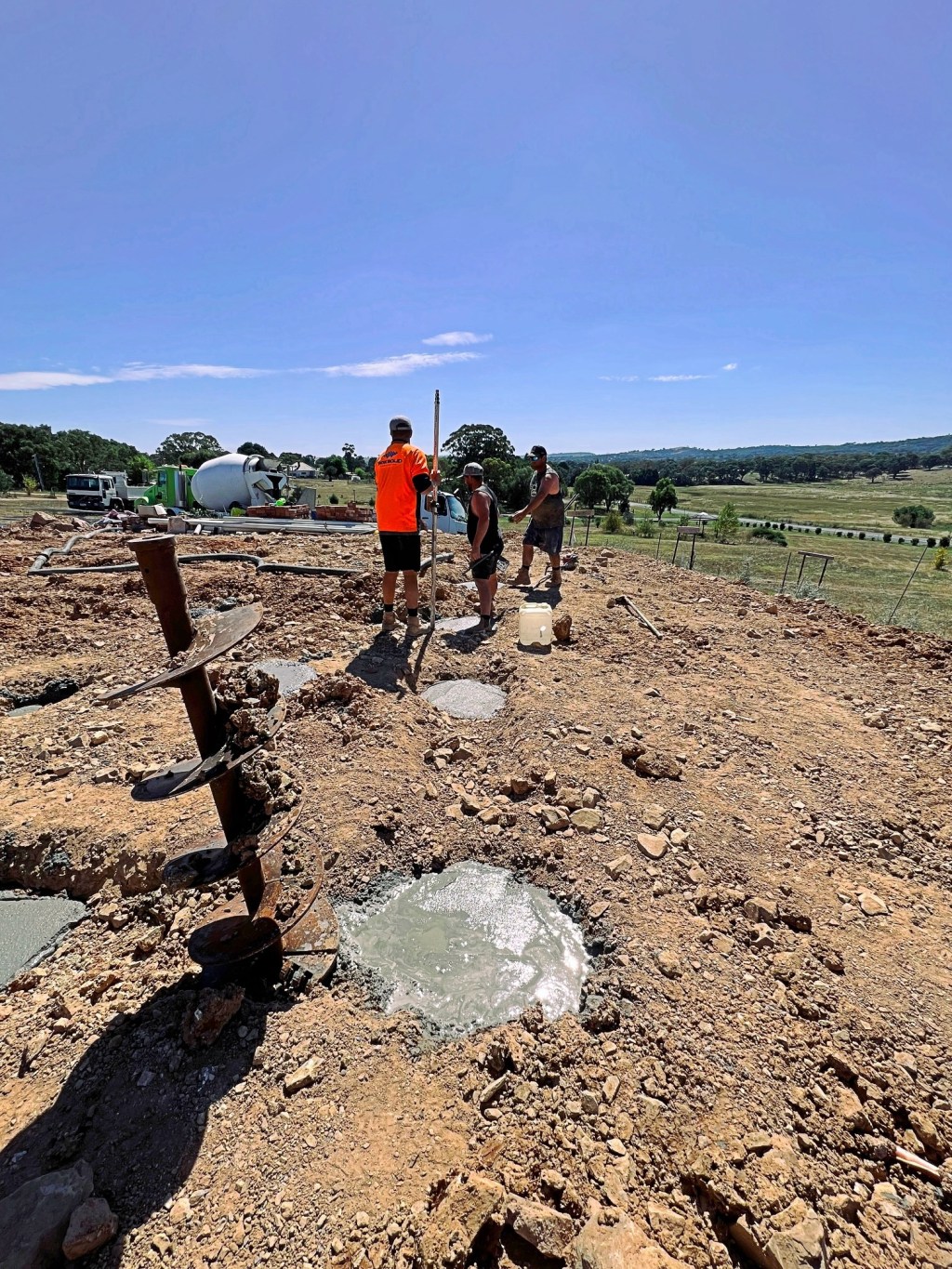
At the time I bemoaned their cost, but perhaps it was all for the best.
When the concrete slab for our passive solar house was being constructed, it was prefaced by the pouring of deep concrete piers. These were needed to support the slab because the house pad is on cut-and-fill, and where the fill was, holes for concrete piers needed to be excavated down to the original level of the ground. The excavating auger met ‘floaters’ (rocks in the fill) that caused it to wander, so every hole got bigger in diameter than the engineer had specified. In turn, this meant that when the holes were filled with concrete to form the piers, much more concrete than originally estimated was needed. In fact, the numerous piers, some as deep as 2 metres, cost about twice as much as I expected.
So what was for the best? As well as the concrete pad being very well supported, I am now starting to think that the presence of the thick piers means it is also much better thermally coupled to the earth – and especially the earth 1-2 metres down (the piers vary in depth). This in turn means that the slab is less influenced by surface temperature variations and more by deeper soil temperatures.
I don’t have any data for subsurface soil temperatures our Canberra climate (only for temperatures 200mm down), but a rule of thumb is that at 2-3m depth, soil temperature is the same as the annual air temp mean, which here is 12-13 deg C.
I am starting to wonder if that’s one reason the house is performing so well in our warm summer – the slab heat is being conducted to the deeper ground, and so is staying cooler than it otherwise would.
Of course, in winter we want the opposite behaviour, however a starting point of (say) 12-13 deg C is much better than an outside temp of zero. Plus, in winter we have heaps of solar insolation coming in to heat the slab.
I’ve never seen any research on thermally deep-coupled slabs – it would be interesting to read.
 Australian Passive Solar Home
Leave a comment