
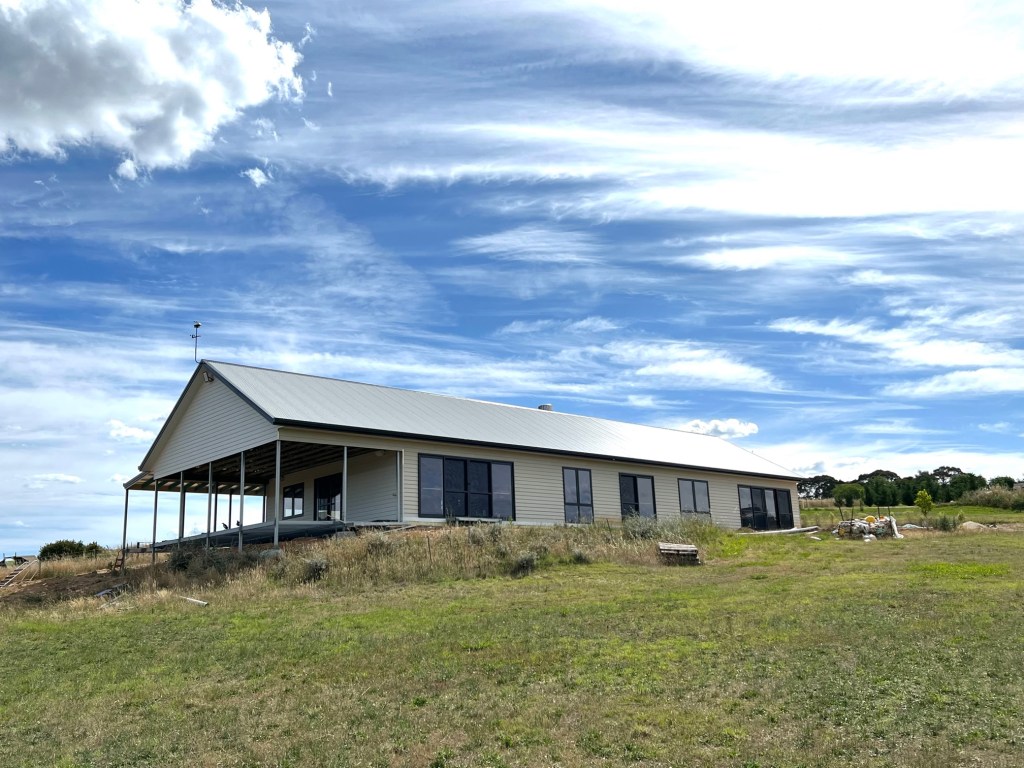
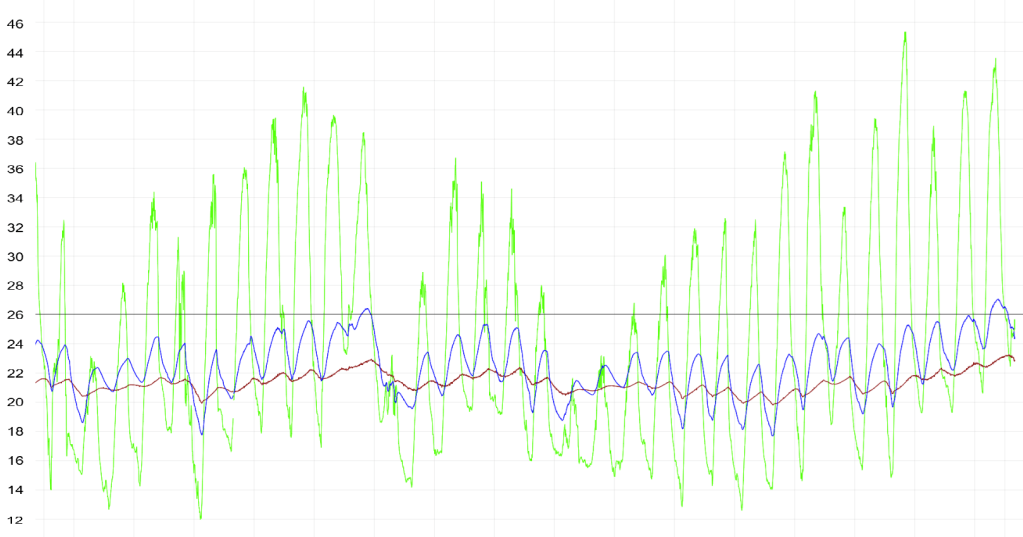
Four lines from the January data logging of our passive solar home, 80km north of Canberra. (The house isn’t quite finished, lead pic.)
Green is outside temperature, blue is inside temperature, red is thermal mass (concrete floor slab) temperature, and the horizontal black line is 26 deg C.
It was a very hot month, with a measured maximum of 44.7 deg C and over half the days of the month being over 34 deg C.
In our climate, these are extreme conditions.
The house was tested without air conditioning. When dressed appropriately and using ceiling and table fans, we found temperatures at and below 26 deg C to be quite comfortable. This is partly because when the thermal mass is 3-4 deg C lower than air temperature, and you’re always exposed to it, the air temp feels cooler. This is a very important attribute of a passive solar house – you’re surrounded by cool surfaces.
Incidentally, the NatHERS cooling setpoint for this climate is 24 deg C, which I think is a bit low. (The cooling setpoint is the temperature at which the air conditioning is switched on.)
If not testing, I think we would have run the air conditioner twice, each time when 26 deg C was exceeded. That would have given an air con run time for the month of about 16 hours, or about 2 per cent of the time. To rephrase that, in this very hot month, we would have had the air conditioning off for 98 per cent of the time.
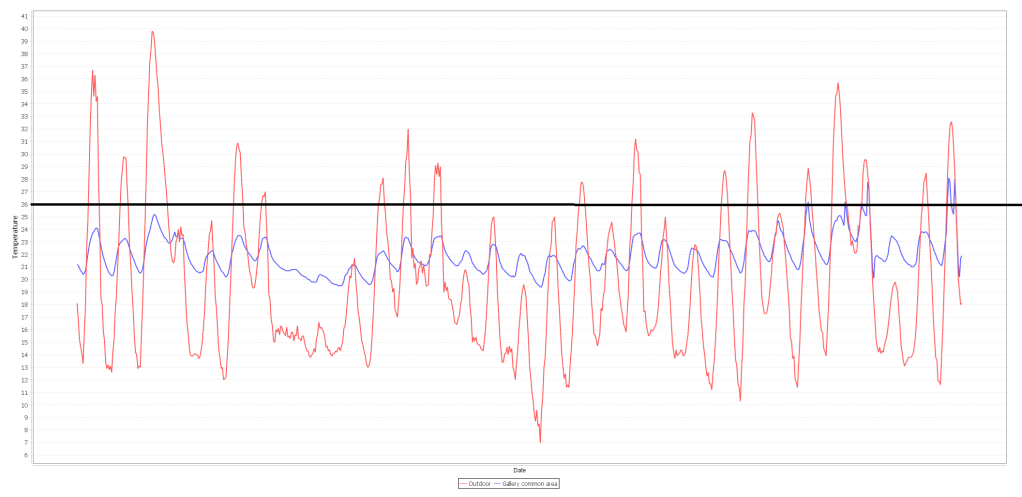
Comparison to the NatHERS FirstRate5 software prediction (above) for January is interesting.
Here the software was used in free-running mode (i.e. no air-conditioning). The software uses Canberra January climate data that has only 3 days exceeding 34 deg C (not the 18 days that actually occurred), and lower daily maxima, but had a similar number of days where the inside house temp was predicted to exceed 26 deg C.
The predicted temperature range shown in the software for the house interior is within 1 deg C of the actual, measured range.
To put this another way, the house interior temperatures are similar to the prediction, but in substantially hotter weather.
Therefore the house is doing better than the prediction, probably because of its increased thermal mass and better ground coupling of the concrete slab. The use of net curtains to reduce indirect solar gain through windows, and having an external ventilated wall cavity to give cooler temperatures behind the cladding, also probably helped.
So the house, using completely conventional Australian construction (no special insulation, no special sealing, no special ventilator, no special accreditation, etc), and built at normal Australian house cost, is doing very well.
 Australian Passive Solar Home
Leave a comment