
Passive solar home design uses four elements:
- Orientation (the directions the windows face)
- Shading (especially of windows)
- Insulation
- Thermal mass (the use of materials within the insulated envelope that can store heat or cool)
In summer, performance is most heavily governed by shading, insulation (just standard NatHERS 7 star wall and ceiling insulation is needed) and thermal mass. (Orientation becomes very important in winter.)
The way passive solar cooling works in summer is this.
On hot days the house is closed – no doors or windows open. Net curtains are drawn over the windows and sliding doors, reducing indirect radiant heat gain. As heat flows through the walls and windows from outside, the thermal mass absorbs the heat, reducing the rate of temperature increase inside the house. At night, when it is cooler, the house is opened to remove the heat stored in the thermal mass.
The best performance comes when there is a high diurnal range – that is, a large difference between maximum day and minimum night temperatures.
Typical summer diurnal ranges for different Australian cities are shown below:
- Canberra – 15 deg C
- Perth – 13 deg C
- Adelaide – 12 deg C
- Melbourne – 11 deg C
- Hobart – 10 deg C
- Sydney – 8 deg C
- Brisbane – 8 deg C
- Darwin – 6 deg C
All cities south of Sydney have adequate diurnal range for highly effective passive solar cooling.
Thermal mass, and the ability to heavily ventilate it at night, are critical to summer performance.
In our house, thermal mass comprises three different elements. These are:
- the concrete floor slab, which makes up the majority of the thermal mass
- the internal water tanks, which act as quick response thermal mass
- the internal feature walls – a relatively minor addition to thermal mass
When the house is finished, and we’re living in it, there will be some additional thermal mass. For example, in our library, the many thousands of books will add thermal mass, especially as being arranged on shelves, they will have good exposure to the internal air. We are also placing a reading table in the library, with the top comprising a 3m x 1m granite slab. That will also add some more thermal mass.
However, summer thermal mass is of little use if it cannot be adequately cooled at night. To ventilate the thermal mass we:
- open the sliding doors
- open the awning windows
- open the ceiling hatches
- and, if the night is still, power the roof-top ventilator
So… keep the house closed during the hot day; open it during the cooler night. If all this sounds very simple, it’s because it is!
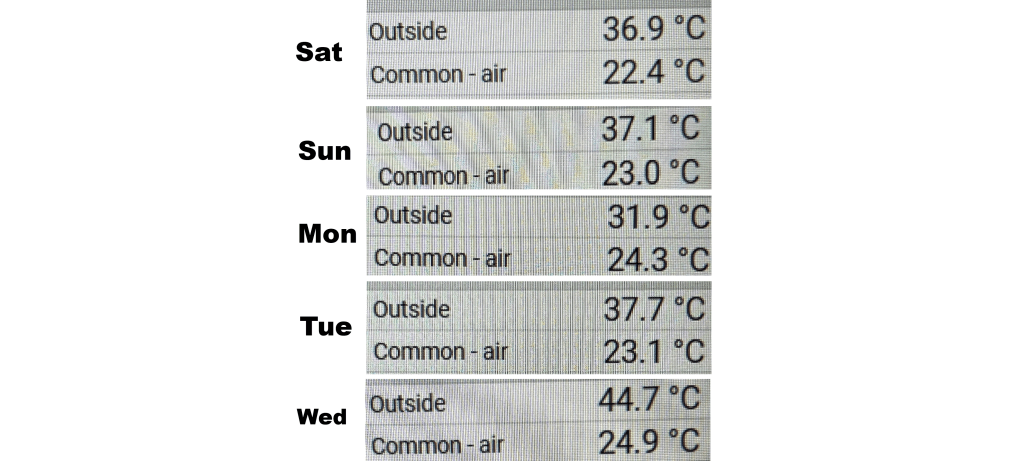
In our house, if the night temperature falls to 18 deg C or below, interior maximum temperature never exceeds 25 deg C, even in heat wave (42+ deg C) conditions. If the overnight minimum is unusually high, e.g. 23 deg C, the interior of the house can reach 26 deg C.
I’d imagine that rare and extreme conditions (a succession of very hot days and, most importantly, of very hot nights) would require the use of an air conditioner. In the 15 years we’ve lived at this location (but not in this house), we’ve never experienced those conditions.
When designing a house to work effectively in hot summers, there are two further points to keep in mind.
The first is that passive solar design must be in the forefront of your mind from the very beginning of the process. It’s no good deciding after the design is 90 per cent finished that you want to build a passive solar home.
The second point is that the readily available and cheap NatHERS software allows world-class passive solar design, an extraordinary advantage for this type of energy efficient architecture in Australia. Any energy rater can run this software for you.
 Australian Passive Solar Home
Leave a comment