
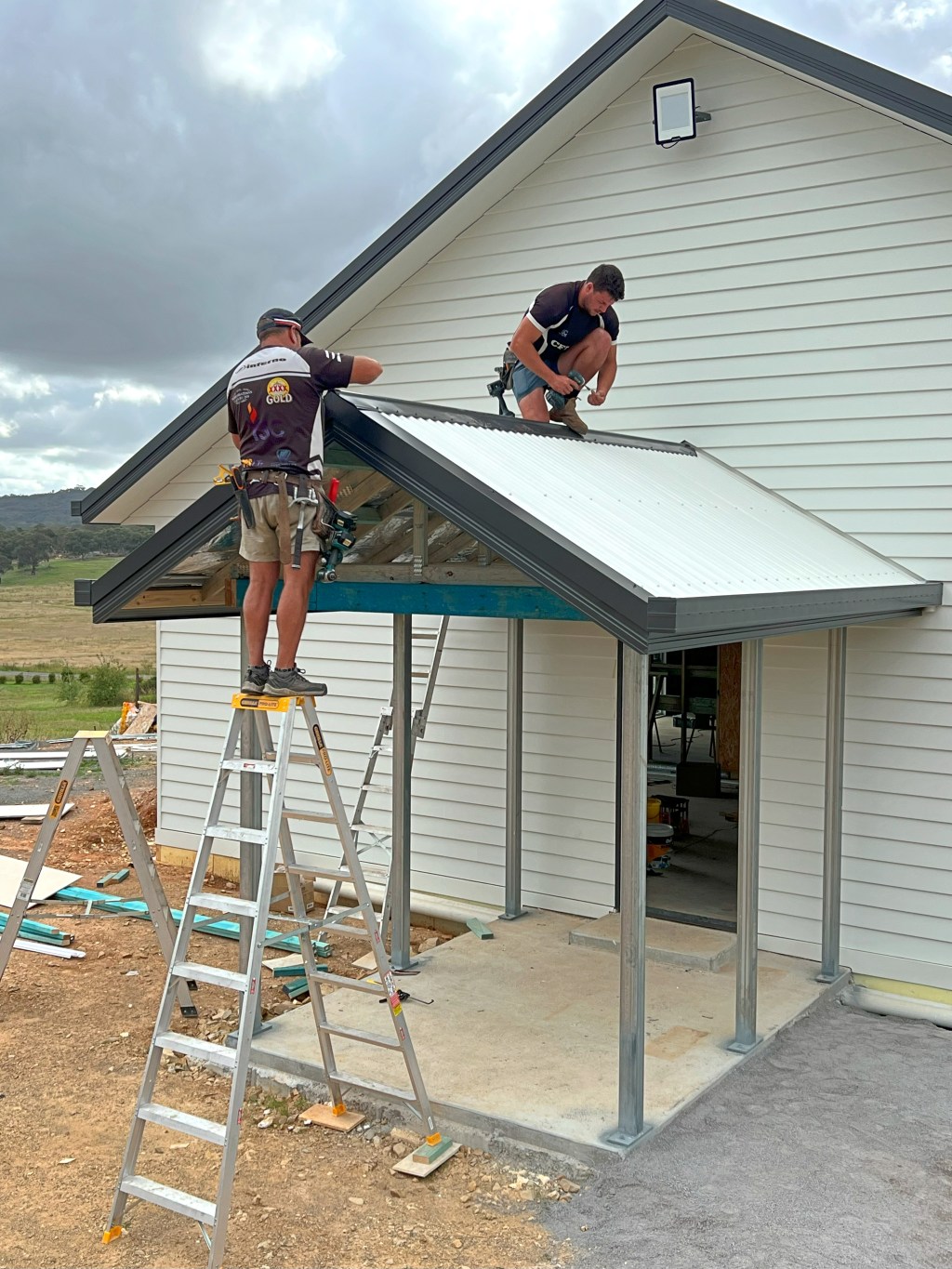
People often say of our house design, “It’s so innovative!”
But no, it’s not – in any way.
That’s the point; that’s why it cost no more than any other Australian standard house.
And there is absolutely nothing in the house that has not been previously published in the technical literature about passive solar building design.
The fundamental passive solar approach? It’s at least 50 years old.
Using internal water tanks? Again, widely published over 50 years ago.
The opening ceiling hatches? In a book published 35 years ago. The southern reflector? Ditto – same book in fact!
The powered roof ventilator? Roof ventilators have been around forever, and powering one is hardly a huge breakthrough.
What about nothing complex?
I was very careful to keep things as simple as possible. An example: I was originally going to use Bowden cables, springs, levers and handles to operate the ceiling hatches. But it rapidly got very complex: much simpler to use a 12V linear actuator and a wall switch.
Another example, that also goes with avoiding approaches that would cost a lot. I was intrigued by the notion of using an internally ventilated concrete slab; all the better for energy exchange. But the approach became increasingly complex and expensive, so I went back to a completely standard concrete slab. (Except for the addition of edge insulation.)
Nothing expensive?
Every single item used in the construction of the house, except for the ceiling hatches that I made from readily available materials, is an off-the-shelf part available from your friendly local building supply company.
The roof? Colorbond. The walls? Hardie Linea cladding. The wall frames and ceiling trusses? Oxley Frame and Truss. The insulation? Knauf Earthwool and Anticon. The tanks? Kingspan. The windows? Thermalheart from Millennium Windows & Doors. The building membrane? Bradford Enviroseal.
Everything used in hundreds of houses every week. That’s why it cost no more than any normal house.
The construction? As an owner-builder, I did things like painting, installing the insulation and so on. But the majority of the house was built by local trades.
When they talk of the energy efficiency of their home, most people in this space mention all the special features. Special windows, special insulation, special sealing membranes, special ventilators, special trades, special testing and special accreditation. (And of course a special price.)
But this house uses literally nothing that is special. That’s the point…
 Australian Passive Solar Home
Leave a comment