
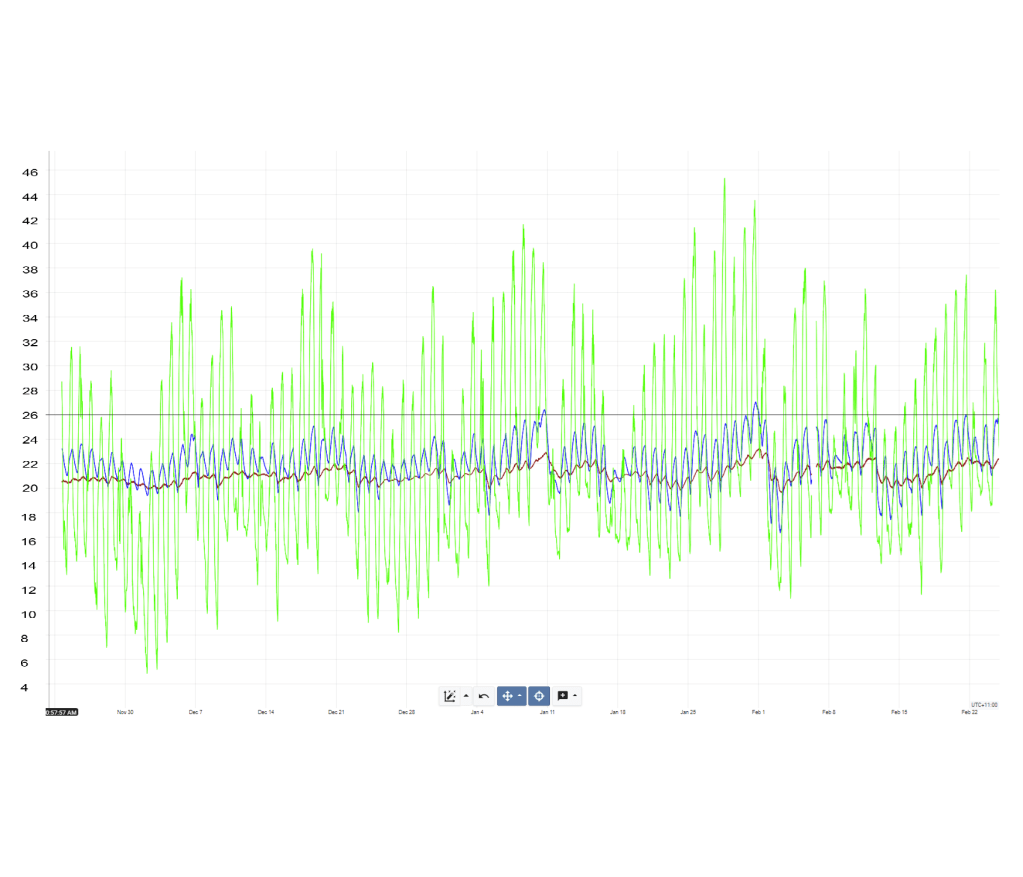
So how did our passive solar house perform over the whole of the 2025-2026 Australian summer – a hot one? Let’s take a look.
(Note: my data logging system had a problem and so needed to be reset just before the end of summer, so I’ve also used the last bit of spring in the 3-month period.)
No heating or cooling systems were used, and the house was opened most nights in January and February for night flush cooling of the thermal mass.
Over summer, the outside temperature peaked at 44.7 deg C (green line). Inside the house, the maximum was 27.0 deg C (blue line).
The horizontal line shows 26 deg C – a temperature that is quite comfortable inside the house. This temperature is comfortable for three reasons:
- appropriate clothing being worn (e.g. shorts and a t-shirt)
- ceiling fans used when needed
- as the graph shows, the thermal mass (red line) is typically 3 deg C cooler than peak inside air temp, and so in summer the house always feels distinctly cooler than air temp.
As can also be seen, if the air con was used at over 26 deg C, it would have operated for about 0.7 per cent of the time. To put that another way, it would have been switched off for 99.3 per cent of the time!
The outside temp minimum was 5 deg C. Inside the house the minimum was 16.4 deg C. This needs further comment: that temp occurred when opening the house on a cool night, but as the logging shows, if wished the house could have been opened less and the interior temp maintained at, for example, 19 deg C.
On the coldest night late in spring (5 deg C) the interior min in the house was 19.3 deg C.
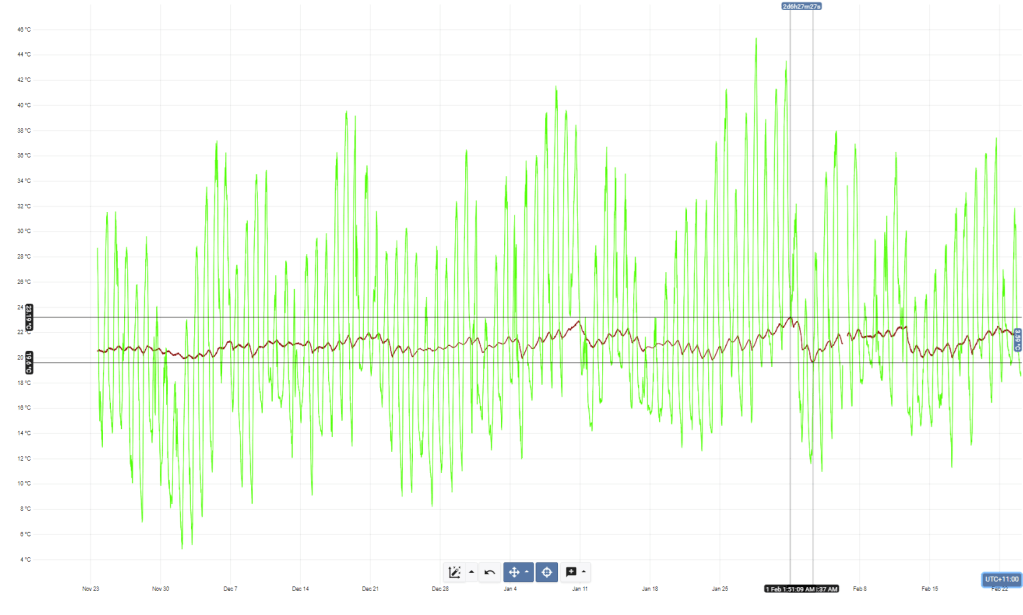
Over the 3 months, the concrete floor slab thermal mass (red line, above)varied in temperature from 19.6 to 23.2 deg C. This is a range of just 3.6 deg C – while at the same time, the outside temperature (green line) varied by nearly 40 deg C! More than anything else, it is the thermal mass that stabilises interior temperatures.
A few other points to keep in mind.
First, this summer was an unusually hot one for this location, with no less than 29 days at, or over, 36 deg C. In contrast, the NatHERS climate file for this climate zone has only 3 days over 36 deg C! Having lived at this location for 15 years, it did indeed feel a hot summer – especially some hot nights.
Second, for the house to work in the way shown in the logging, the occupants need to be involved with how the house works. In this case, that means opening and closing doors and windows when appropriate. That was usually straightforward: open the house in the early evening and close it in the early morning. However, on a few nights, the outside temp didn’t drop far enough to open the house until late evening e.g. 11pm.
Third, many data log records I have seen for houses show the interior temps with air con / heating running. That’s fine, except it makes seeing the performance of the house itself very difficult. Also, some records show short periods, e.g. a week. As can be seen for the above 3 months of data, it’s easy to pick a week that looks particularly good!
And what about other parameters?
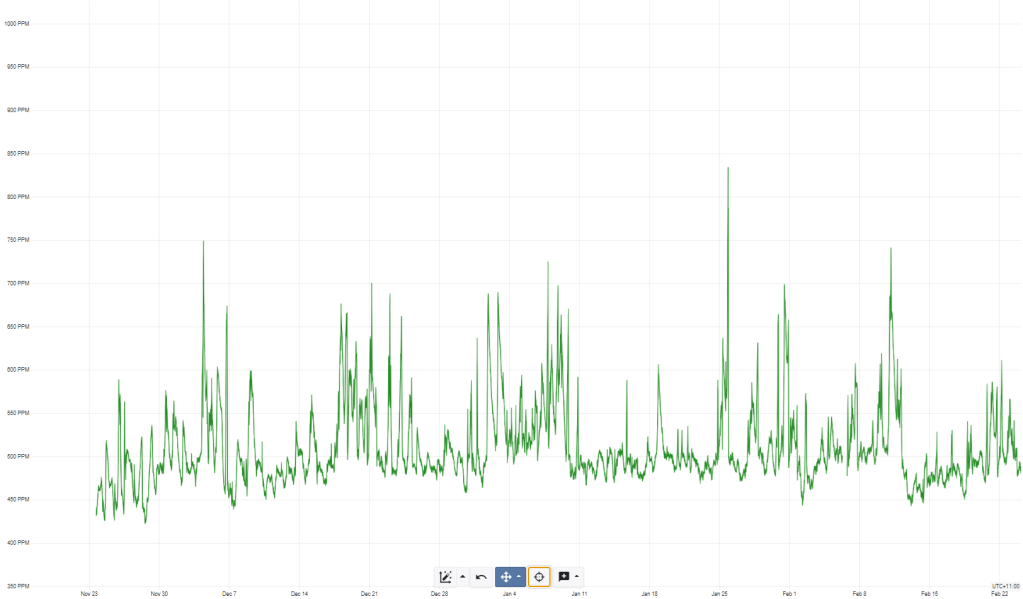
Carbon dioxide (above) had a one-off peak of 840PPM but the average was about 550PPM – to be expected when the house is not tightly sealed and was being frequently opened. This is a very low level of CO2, indicating the air in the house is very fresh.
Interior dewpoint varied from 5 to 20 deg C, with an average of about 12 deg C. Over about 15 deg C dewpoint we used the fans, otherwise it could feel a bit sticky. (It’s a normally dry climate here, so we’re very sensitive to higher dewpoint temperatures.)
Relative humidity varied from 30-80 per cent, with an average of about 55 per cent. It was in the 40-65 per cent range the vast majority of the time.
Much more data will be covered in my book on passive solar houses (and of course this house), to be published mid-2026 when I have 12 months of measured data for the house.
The most important point about all of this is that the house uses completely conventional Australian construction techniques – no special membranes, no special insulation, no special high performance windows (just off-the-shelf double glazed), no special external doors, no special sealing, no special trades, etc. As you’d then expect, it cost no more than a normal Australian house to build (in fact, as I was an owner-builder, it cost less). Its performance is primarily achieved through normal NatHERS 7 construction and careful passive solar design (orientation, shading, natural ventilation), none of which cost anything.
Furthermore, nothing in this house design is unique or new. It’s all been covered in the technical literature of the last 50 years.
What has changed over that time is the availability of excellent quality house modelling software – in Australia the vastly underestimated NatHERS packages. These packages, some of which are free, allow the modelling of the house with what I have found is superb accuracy, allowing highly cost-effective decisions to be made (e.g. how much insulation do you actually need?), in addition to seeing the effects of altering shading, orientation and thermal mass.
The proof of the pudding is in the eating: this house is performing in summer better than some energy efficient houses that cost over twice as much per square metre. Designing an energy efficient house for the local climate doesn’t need to be expensive or difficult.
 Australian Passive Solar Home
Leave a comment