
One of the two excellent ideas I gained from Derek Wrigley’s much underestimated book ‘Making Your Home Sustainable’ is the ceiling ventilation hatches used in our new passive solar house, being built north of Canberra. Wrigley used simple hatches operated by cord pulls, whereas mine – for the reasons I’ll outline in a minute – use a more sophisticated design.
The purpose of the ceiling hatches is to provide convectional ventilation in summer. Hot air rises, and so the hottest air in a room is found near the ceiling*. Therefore, opening a ceiling hatch allows this air to flow into the roof space, which in turn can be ventilated, preferably at its peak. Of course, the room air that flows out needs to be replaced, and this can be achieved by an open window or door. The result is a convectional airflow that needs no wind or cross-ventilation to operate. It’s a very simple idea, and that in turn gave me the confidence to adopt it in our new house.
However, I was unconvinced by Wrigley’s pull cord hatch operation, and I also wanted the closed hatch to both tightly seal and provide a similar insulation level to the normal ceiling insulation. These points were achieved by using a thick layer of XPS insulation glued to a plywood base for the hatch panel, fitting a foam rubber compression seal around its lower edge, and operating the hatch by a 12V linear actuator that pulls the hatch panel tightly closed against its seal. 12V actuators are very simple to use, as they have limit switches built in and can be operated by just a DPDT wall switch – one position for open, the other for closed. The hatch, frame, hinges and actuator were all cheap and easy to construct into a working system. (As it’s 12V, any handyperson could build it.)
Four hatches are fitted in the house. Two are in ceilings as described, and the other two are in the two end rooms that have raked ceilings and so tall walls. These hatches are in the upper part of the walls and again open into the roof space.
The roof space is ventilated by a 600mm wind- and DC motor-powered commercial ventilator mounted at the apex of the roof. (As in Wrigley’s approach, the roof space is regarded as being part of the outside environment – its temperature (again measured) stays close to ambient.)
The interior hatch openings are covered by normal air conditioner return grilles, that incorporate a fine screen that can be removed for cleaning.
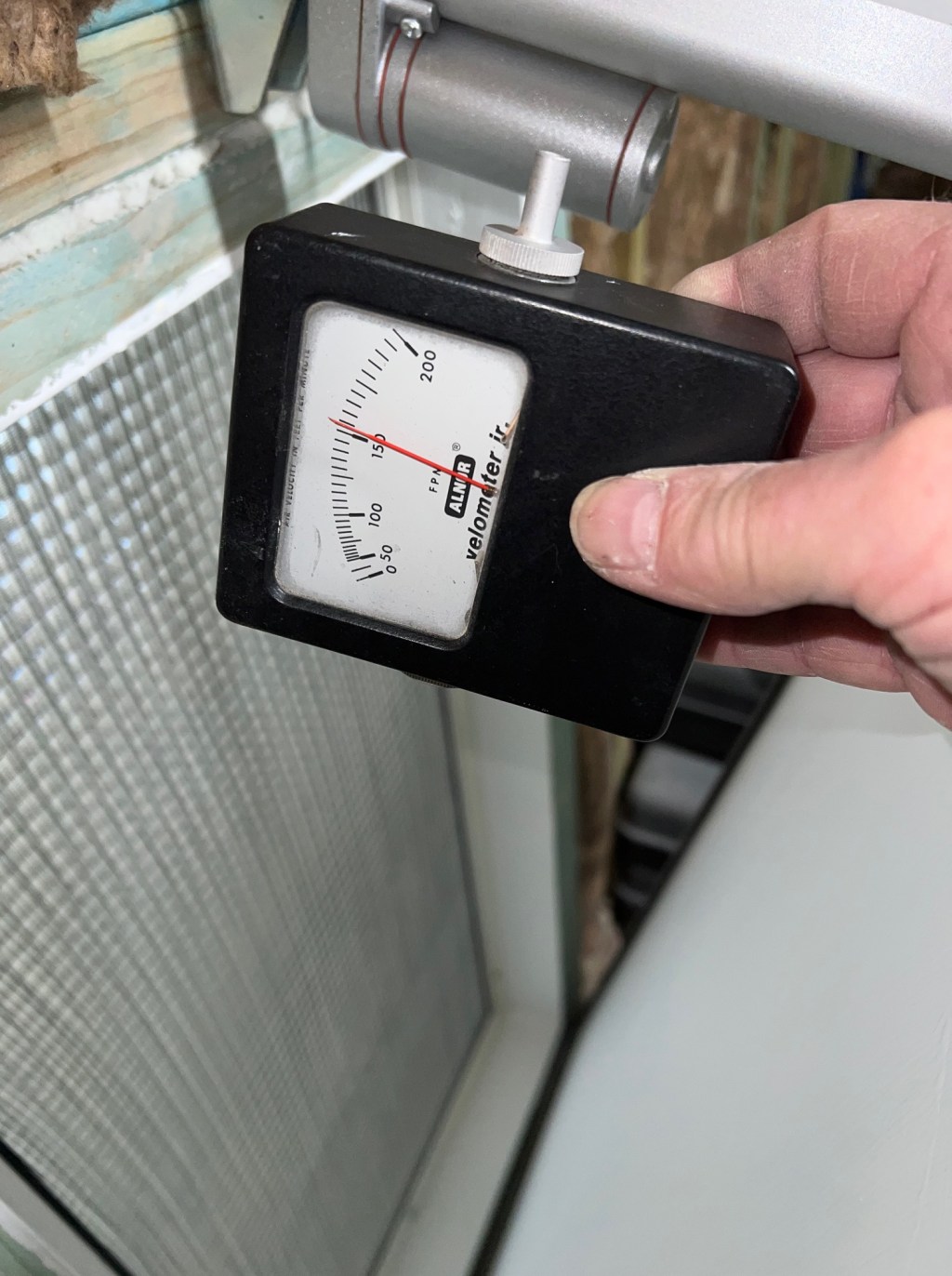
So far, my measurements show that the system works very well. Cheap, simple, low in both operating and embodied energy, and very effective.
Incidentally, Wrigley’s book was self-published in 2004.
(*Actually, as my logging shows, that’s not always the case!)
Electrically opening ceiling hatches for ventilation flow
 Australian Passive Solar Home
Leave a comment