
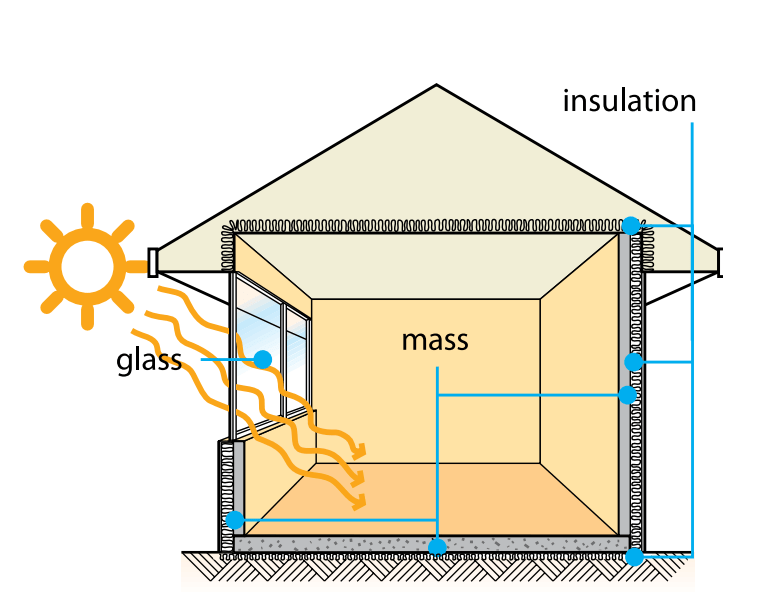
When mention is made of a ‘solar house’, many people think of solar cells – photo-voltaic panels that generate electricity. However, a passive solar home may or may not have solar panels.
Instead, the house is designed and used so that it is warmed in winter by the action of the sun, and is cooled in summer, primarily by its internal surfaces acting as a heatsink.
However, for a home to work in this way, its design is critical. Design aspects include:
• the size of windows and the direction they face
• the internal heat storage capabilities of the house (called ‘thermal mass’)
• shading
• insulation
• ventilation
In addition, such a house requires the participation of the occupants who understand how the design best functions.
An active / passive solar home has a much-reduced energy consumption for heating, cooling and lighting. Furthermore, it is a comfortable house which works in harmony with nature. That might sound a ‘feel good’ statement, but by that I mean that the internal temperature varies to reflect what is happening outside – but without the extremes. Unlike an artificially heated and cooled house, where the temperature is held constant by a thermostat, in a solar home the inside temperature still changes. To me that seems much more natural.
Another aspect of a solar home that makes it comfortable is that the temperature of the internal surfaces – as well as the internal air temperature – work in your favour. That is, in winter those internal surfaces are warmer than they would otherwise be (they have stored the heat from sunshine) and in summer they are cool (they act as a heatsink). This is a subtle but very important point in terms of comfort.
Something else that matches the house functioning to natural human mechanisms are cooling airflows. In summer, cooling of people is achieved in part by the action of airflow evaporating perspiration – so it works in concert with the body’s natural cooling mechanism. Using ceiling fans is an example of this.
A passive solar house is one filled with light. Except on exceptionally dull days, during daytime artificial lighting is not required in nearly all the rooms.
Passive solar is the answer to creating a healthy and comfortable house at normal cost. No other energy-efficient home design approach in Australia can simultaneously achieve all three!
 Australian Passive Solar Home