
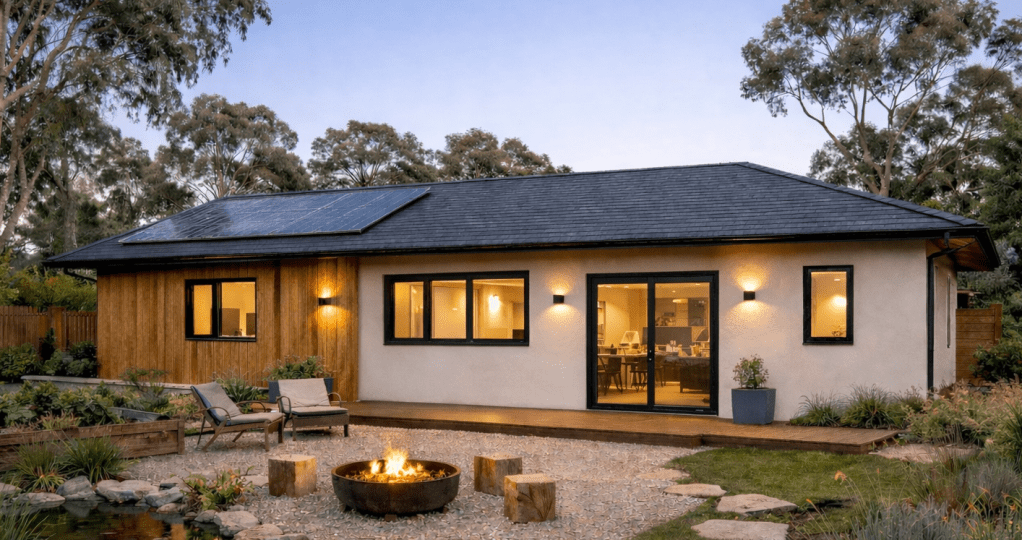
If you’re interested in energy efficient building in Australia, you are sure to have come across Passivhaus. So what is it, and why do I think that in Australia it is largely a giant scam?
First, let’s look at what Passivhaus is.
The approach
The Passivhaus approach to energy-efficient architecture is best summarised as being a rigorous, voluntary standard for energy efficiency in buildings. Its key principles are:
- super-insulated building envelopes
- airtight construction
- very high-performance windows and external doors
- mechanical ventilation, often with heat recovery (i.e. the use of a heat exchanger)
- construction without thermal bridges
While orientation and thermal mass can be used in Passivhaus, they are not required. In effect, the house is so heavily insulated and sealed that solar energy gains from the north, and storage of those gains, are not needed.
Passivhaus criteria requires maintaining the entire interior of the house (i.e. no zoning) at a temperature between 20-25°C all year.
The airtightness criterion is such that mechanical ventilation is a necessity to provide the occupants with adequate fresh air.
Energy used for heating and cooling must each be less than 15kWh/m2/year. That is, in a house needing mechanical heating and cooling to meet the temperature criteria, 30kWh/m2/year can be used. Nearly all Passivhaus designs I have seen described in Australia use mechanical heating and cooling systems.
The standard was developed in northern Europe, but houses built to Passivhaus criteria have now been constructed around the world.
Passivhaus promotional material
What I have observed in reading the Australian Passivhaus promotional material, and communicating with Passivhaus proponents, is that promotion of Passivhaus is often highly deceptive. Some promotional points are simply wrong, and many are deceptive by omission.
The following Passivhaus promotional points are common.
Point 1: “Passive Houses are designed to be incredibly energy efficient, up to 90% more efficient than a typical Australian home (cooling and heating).”
Reply: As we have seen, an accredited Passivhaus can use a maximum of 15kWh/m2/year for heating, and a maximum of 15kWh/m2/year for cooling. If we take the average Australian new house size of 230m2, that means than such an accredited Passivhaus can have an annual energy use for heating and cooling of 6,900kWh per year.
However that is energy demand, not required energy. If all that heating and cooling is done by reverse cycle air-conditioning (i.e. a heat pump), with a Coefficient of Performance of (say) 3, that drops required energy to 2,300kWh per year.
At the time of writing (2026), the average annual electricity consumption of an Australian non-gas household is about 6,400kWh per year, with about half that (3,200kWh per year) used for heating and cooling.
So an accredited Passivhaus can use 70 per cent of the heating/cooling energy of an average Australian house of the same size. That’s not what you’d think when reading the promotional point!
Point 2: “A Passivhaus is so energy efficient that the cost to heat or cool an entire 100m2 house for a year is scarcely more than the energy used by a late-model fridge.”
Reply:
First, note first how the text says to heat or cool – for the comparison, you’re not allowed to do both. So let’s go with just heating. We know that the Passivhaus limit is 15kWh/m2/year. So, for a 100 square metre house, 1,500kWh.
Let’s assume that all that heating and cooling is again by reverse cycle air conditioner. The Coefficient of Performance (say again 3) drops that to 500kWh per year purchased energy.
So how does a “late model fridge” compare?
Refrigerator wattage = 130 Watts
Estimated usage = 8 hours per day (33% duty cycle)
Total energy = 130W x 8h = 1040Wh = 1.04kWh/day
365 days = 380kWh.
So the Passivhaus, within its certification limits, can use 30 per cent more energy than the fridge. I’ll let you decide if that’s ‘scarcely more’.
However, if we include cooling of the house, we can add another 15kWh/m2/year (500kWh, taking into account the COP). So now we’re up to 1,000kWh which would, within the Passivhaus certification limit, make it more than 2.5 times the energy use of the fridge.
Furthermore, a 100m2 house is less than half the size of an average Australian house. So for a normal house, more than double these Passivhaus energy use figures again!
We’re certainly getting a long way from the energy use of a fridge.
Point 3: “Q: How much extra will [a Passivhaus] cost? A: Not much. In fact, smart design can deliver Certified Passivhaus performance for the same or even less than an equivalent house built to the Building Code-minimum standard.”
Reply: There is not even one accredited Passivhaus that I can find in Australia that cost the same, let alone less, than “an equivalent house built to the Building Code-minimum standard”. (And if you know of one, can you please tell me?) In fact, a Passivhaus typically costs 50-100 per cent more than the average cost of an Australian house (easiest measured on a $ per square metre basis).
Point 4: “A Passivhaus uses computer software designed to give a guaranteed energy-efficient house with specified comfort levels.”
Reply: Yes, a Passivhaus is modelled in a software package called PHPP that predicts the energy performance of the design. However, there’s no need to build a Passivhaus to software model the efficiency of a home design. In fact, energy-efficiency software is already used to check, within specified comfort levels, the energy consumption of pretty well all new Australian house designs. The program is called NatHERS and is backed by the Australian Government and its research organisation, the CSIRO.
Point 5: “Passivhaus is based on rigorous engineering and scientific principles.”
Reply: Yes – and so are lots of other design approaches to energy-efficient housing.
Point 6: “A Passivhaus is constructed to a higher quality than a traditional Australian house.”
Reply: The quality of the construction of any house depends largely on the builder and the process of inspection at interim stages within the build. You don’t need a Passivhaus to have good quality home construction.
Point 7: “Unlike other homes, a Passivhaus is tested for airtightness at the end of the build process.”
Reply: Any house can be tested for airtightness at the end of the build. You don’t need a Passivhaus to have an airtightness test done.
Point 8: “Because of its mechanical airflow, a Passivhaus prevents the development of mildew and mould.”
Reply: In all houses it is important that moisture-laden air is removed from the house. That occurs in a Passivhaus by use of the mechanical ventilator. In a passive solar house, bathroom and kitchen rangehood exhaust fans can perform the same function for the air containing the greatest amounts of moisture.
Point 9: “The air quality in a Passivhaus is always excellent because the ventilator keeps levels of CO2, VOCs and formaldehyde low.”
Reply: The level of those parameters will depend on how the ventilator is used. So if you’ve just put in new curtains with high initial outgassing of VOCs, you will need to turn up the ventilator. If you are having a gathering of people at your house, you will need to alter ventilation flow to keep CO2 levels low. Often the implication is that, rather magically, air quality in a Passivhaus will be fine – just because there is a mechanical ventilator operating. But the research I have seen suggests it all depends on how you operate the ventilator – just like in a normal house, how you open doors and windows for ventilation…. an approach that doesn’t cost anything!
Point 10: “It is wonderful when people see the Passivhaus light, and realise they can have an energy-efficient, healthy house with the right comfort levels all year around.”
Reply: Yes, and those attributes are available through other energy efficient house techniques too, and at a much lower cost.
Conclusion
As we have seen, much Passivhaus promotional material is highly misleading. In fact, I would go as far as to say that nearly all material I have seen promoting Passivhaus in Australia contains major errors of fact or omits critical information. Often, this is because the same promotional points are just blindly repeated without fact-checking or detailed analysis.
There is of course no problem if you have analysed the cost versus benefits of the various approaches to energy-efficient house design and then decide to build a Passivhaus – that’s absolutely your choice. Also, in some locations, passive solar, as described on this blog, may not work very well – for example, where northern windows cannot be used, there is extensive shading of the site, it is a very noisy location where windows or vents cannot be opened for night cooling, and so on. There is certainly a role for Passivhaus in the architectural range of energy-efficient home approaches.
However, for southern Australia, perhaps alpine areas excepted, Passivhaus is usually expensive overkill for our mild climate. In the vast majority of locations, passive solar design is much cheaper and still highly effective. It’s why all the Australian State and Federal governments recommend passive solar in their house design literature – and Passivhaus barely gets a mention.
Note: An earlier version of this post did not take into account the Coefficient of Performance of using a reverse cycle air conditioner to do the heating and cooling in a Passivhaus. This has now been corrected.

 Australian Passive Solar Home
Leave a reply to Julian Edgar Cancel reply