
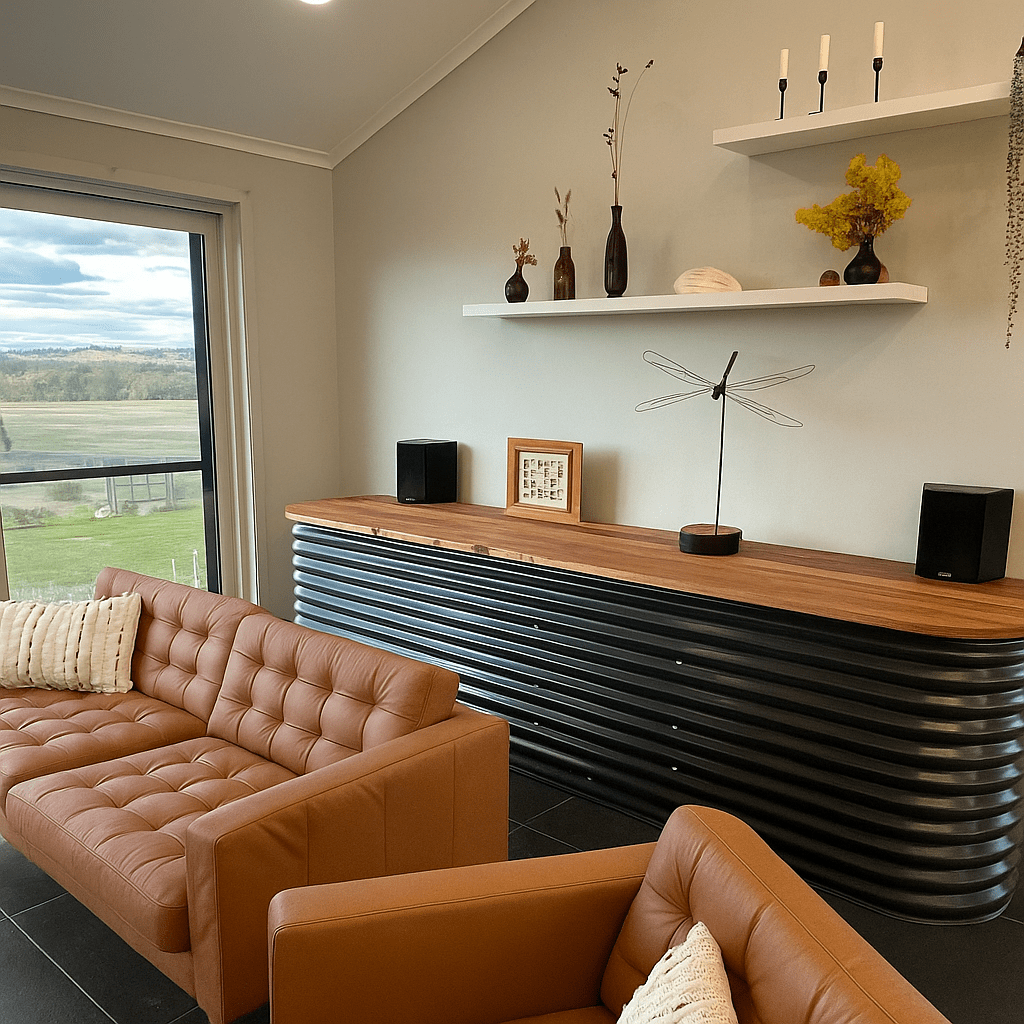
Question: I don’t understand how your internal water tanks work to warm the house. Is there a heating element in the tank?
Answer: The lounge water tank doesn’t have a heating element in it. What happens is this.
Imagine that both the late afternoon daytime air temperature in the room, and the temperature of the water in the tank, are at 21°C. It’s winter and as night draws near, the outside temperature starts to fall. Because of heat loss through the walls, ceiling and windows, the inside air temperature also starts to drop. As the inside air temperature falls below tank temperature, heat starts to automatically flow from the tank to the air in the room. The greater the difference between room air temperature and tank temperature, the more heat that flows. Therefore, because of the tank, the room air temperature is higher than it would otherwise be – the room is being heated. The air temperature stays higher until the tank temperature is the same as room temperature – all the heat has been used.
So what happens the next day? At dawn, both the room and tank temperatures might be 18°C. Winter sunshine warms the room, and everything in it. By 10am the air temperature in the room might be 19°C, and so heat flows from the room air into the tank. Because the tank is absorbing heat, the air temperature rises more slowly than it otherwise would, but rise it slowly does. By – say – 3pm the tank and room temperatures have equalised, and the tank is storing warmth, ready for its role that evening.
There are a couple of things to note. First, the tank is called ‘thermal mass’ because it resists the change in room temperature – both upwards and downwards. Second, the tank temperature is never greatly different to the room temperature – at any time there’s normally less than 2°C difference. Finally, if there is no winter sunshine, the tank temperature will not rise much during daytime. (This is why the tank is only part of the thermal mass of the house – the concrete slab ‘works’ over periods of multiple days.)
Question: I understand how the internal water tank keeps the room warmer in winter. But how does it work in summer?
Answer: This time, let’s start at dawn on a hot summer’s day. The house windows have been open all night, allowing the cool night air to circulate through the house. This cool airflow has reduced the tank water temperature to – say – 18°C. As the day warms up, so does air in the room. When the air temperature of the room warms above tank temperature, heat flows from the room air to the water in the tank. This slows the rate of increase of the air temperature in the room – the tank is keeping the air temperature cooler than it would otherwise have been. The tank continues to work as a cooler until the air and tank temperatures have equalised. Again, a couple of things to note. To be effective in summer, there needs to be sufficient diurnal range – that is, the night minimum temperature must be quite a lot cooler than the daytime maximum temperature. Secondly, the active participation of the house occupants is needed – at night the house must be opened so that the cool air can cool the tank, and then the house closed early the next day.
Question: You could have connected your internal water tanks to in-slab heating pipes which would have better used the thermal mass. Also, when heating is needed, you could have used the same pipes to provide this.
Answer: From a passive solar perspective, that would be both much more expensive and complex, for little or no gain. From an artificial heating perspective, that would require an expensive heat source and would give slab heating – not what was wanted because it is slow in response.
Question: Instead of using water in your internal tanks, you could have used phase change materials (PCMs) which would have stored a lot more energy.
Answer: I looked at PCMs in detail when designing the house. Yes, water stores less energy than PCMs but it has many other benefits – it is available onsite and is cheap, simple, non-toxic, chemically stable and can have an infinite number of heat/cool cycles.
Question: Not everyone wants to have ugly water tanks in their house that look like raised garden beds.
Answer: And they don’t have to! Thermal mass can be provided in a number of ways, including for example via internal brick walls that look completely normal. We chose to use the water tanks as additional thermal masses, and interestingly. many people have commented that they look good.
Question: We’re thinking of using freestanding galvanised steel culvert pipes to contain water for internal thermal mass. The pipes will be 610mm in diameter and 3 metres long. Four will be positioned vertically at each end behind a tall northern window. What do you think?
Answer: From a house energy perspective, they’ll likely be very good. The biggest issues are structural. Each pipe will weigh about 90kg; when full of water, this will increase to just under 1 tonne. The foundation will need to be suitably designed, and to give stability, the pipes will need added flanges and to be bolted to the foundation. (For example, consider what might happen in an earthquake.) Consult a structural engineer – it should be a straightforward design task, but it will need proper engineering. Provision to allow easy filling and emptying of the pipes will also be wise.
Question: Aren’t you worried about the internal water tanks flooding your house?
Answer: It’s extremely unlikely that the water tanks will fail catastrophically. Any slow leak, although also unlikely, would not be a major issue – the tanks are easily emptied.


Leave a Reply